En Eluttukal

  • About
  • Blog
  • Contact
  • ☰
    • Essays
    • Reviews
    • Groundhopping
    • Feautured

  • A Caribbean Catastrophe

    (Originally published on July 8th, 2023)

    It is 9th July 2023. Eight days ago, the West Indies Men’s Cricket Team lost to Scotland. Thirteen days ago, they lost to The Netherlands. And, fifteen days ago they lost to Zimbabwe. After three consecutive losses in the 2023 World Cup Qualifiers, they have officially failed to qualify for the Men’s Cricket World Cup – for the first time ever. It is a sad occasion for cricket in the Caribbean, and cricket in general, as the decline of a major protagonist is reaching its final stages. With the absence of the West Indies on cricket’s biggest stage, it feels like the world’s second most popular sport (and what is considered a truly global sport) is losing some of its comprehensiveness.
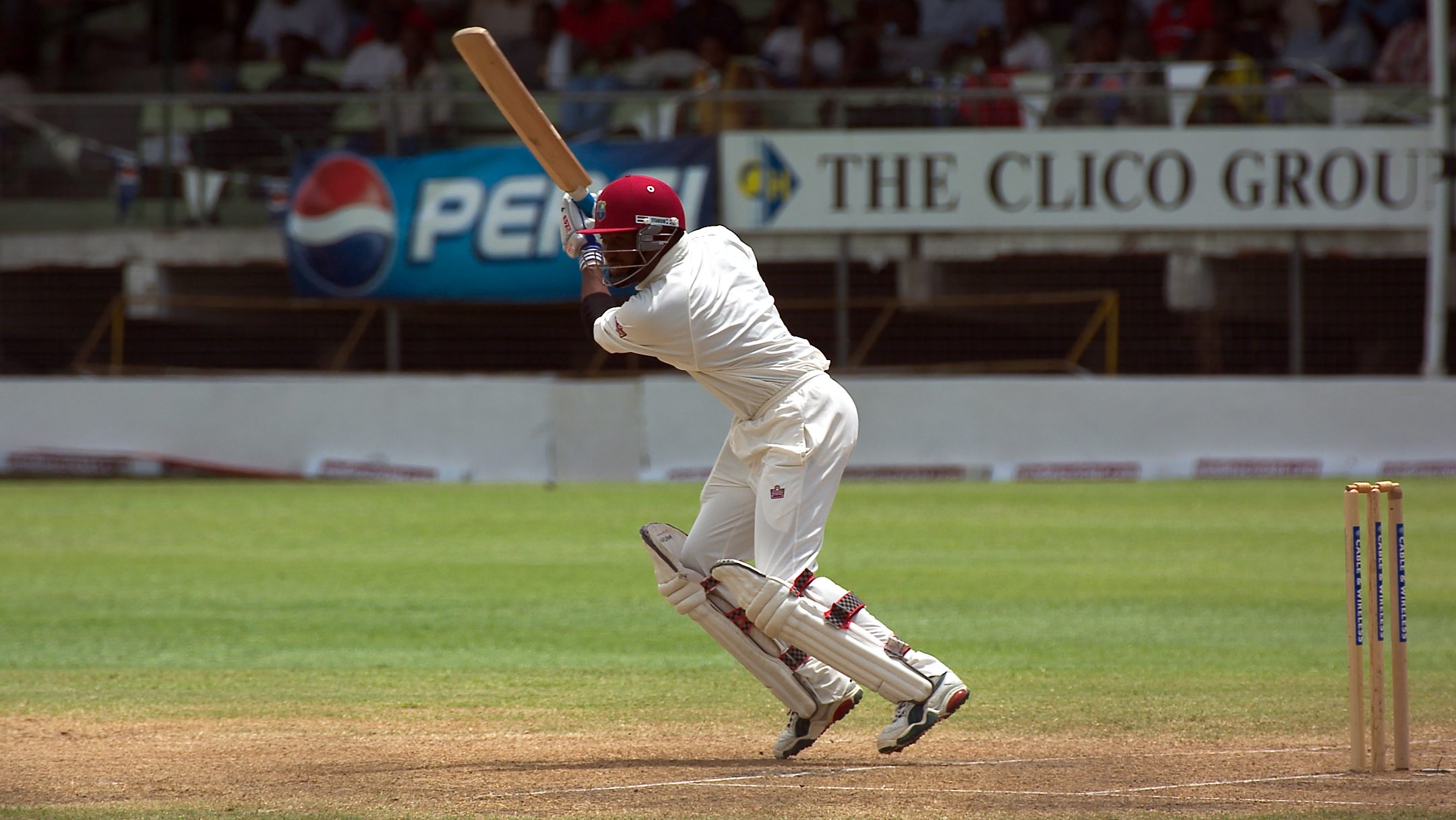
    Brian Lara, one of West Indies’ (and cricket’s) finest batsmen, in action against India in May 2002 (Ukexpat, CC BY-SA 3.0 <http://creativecommons.org/licenses/by-sa/3.0/&gt;, via Wikimedia Commons).

    West Indies Cricket has always been defined by greatness. It started in the mid-1970s when the West Indian Cricket team, led by Clive Lloyd and fueled by racial abuse, transformed itself from ‘fun-and-frolic, happy-go-lucky losers’ to World dominators. Unfortunately, I was not alive to witness their achievements but through my grandfather’s stories of the ‘fearsome foursome’ and Viv Richards’ nonchalant yet invincible batting, I think I got the idea. The Windies won two World Cups (1975 and 1979) and did not lose a test series for 15 years. In the mid-90s, their Test supremacy began to decline but they soon found another format to rule – Twenty20.

    With fast bowling not being so much of a weapon anymore, the West Indians became known for their power hitting in the 2010s. Players like Chris Gayle, Keiron Pollard, Andre Russell, and Marlon Samuels made clearing the fences look easy, and helped transform the Windies into a T20 powerhouse. They were the first team to win two T20 World Cups (2010 and 2016) and in 2016, they became the only side to hold three World Cups simultaneously (Men’s T20, Women’s T20 and the under-19 World Cup).

    However, the West Indies are no longer competitive even in the shortest format of the game, as they failed to make the super twelve in the 2022 T20 World Cup. Last week’s defeat to Scotland and failure to qualify for the 2023 World Cup shows that WI did not just stumble in 2022, they began their free fall. The question on everyone’s mind, especially those who experienced their glory days, is ‘what happened to West Indies Cricket’? After a lot of digging, here are some of the many reasons contributing to the downfall of Caribbean Cricket.

    Following West Indies’ loss against Scotland last Saturday, former West Indian cricketers turned commentators Ian Bishop and Carlos Braithwaite agreed that this was the lowest of lows. After dissecting the performance of the team, Bishop turned to Brathwaite and asked him what the challenges are for West Indies Cricket going forward. In response, Brathwaite laughed a hapless laugh and said, ‘I think there are a lot of issues Bish’ before calling out the management for entering an endless cycle of talent identification, which they then fail to develop. He said the ‘last crop’, from four years ago, included Sherfane Rutherford, Fabian Allen and Oshane Thomas – none of whom featured in the WI squad for these past qualifiers. Now, they are already searching for ‘new crop’. After a mild rant from Brathwaite, that covered numerous other shortcomings of WI cricket, Ian Bishop concluded the post-match conversation saying, ‘it is a systemic problem, and we need a new system’. This discussion summed up the feeling amongst ex-West Indian cricketers and fans who probably find it quite difficult to fathom how deep the ship has sunk.

    Last year, after West Indies’ premature exit in the T20 World Cup, Brian Lara (another former WI cricketer and one of the game’s greatest batsmen) blamed the ‘lack of example’ in the dressing room, due to which newcomers did not feel a sense of pride in donning the burgundy hat. He said, ‘I believe the example being set now, is of guys heading off to franchise cricket. Everybody wants to make a lot of money out of the game, and West Indies seems to be very much secondary’.
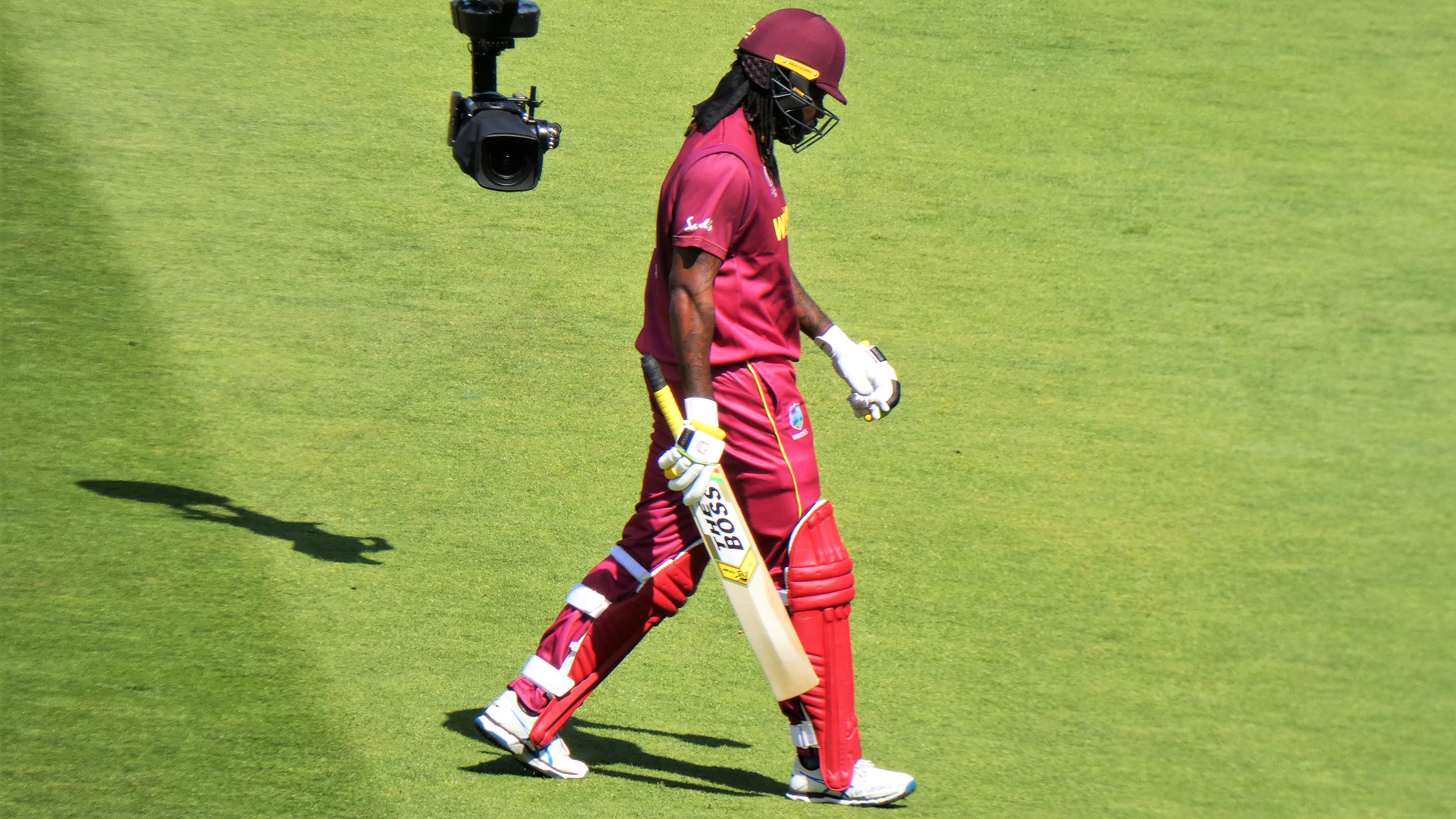
    Chris Gayle – the face of WI cricket in the past decade and certainly the most destructive batsman the game has ever seen (It’s No Game, CC BY 2.0 <https://creativecommons.org/licenses/by/2.0&gt;, via Wikimedia Commons).

    This is true, as established and experienced players like Keiron Pollard, Sunil Narine, and Andre Russell are all still playing franchise cricket, despite having retired from the international scene. Even Shimron Hetmyer, who is only a rising star, has not represented the Windies since he missed a rescheduled flight to the 2022 T20 World Cup. He too is doing well in leagues around the World, from a monetary and performance perspective.

    However, before we start pointing fingers, it is important to consider Cricket West Indies’ (CWI) long history of not picking its best players and having poor relations with its stars.

    Desmond Haynes, CWI’s lead selector on the men’s side said Hetmyer did make himself available for the 2023 ODI World Cup Qualifiers but was not picked. He said that the team management wanted to stick with a unit similar to the one that did well in the limited-overs series in South Africa earlier this year (In the limited-over series in question, West Indies drew the ODI series 1 –1 and won the T20 series 2 – 1: not the largest sample size). Given West Indies’ dire situation, it is amusing that CWI continues to make enemies with its biggest prospects.

    When Sunil Narine, who was the World’s best spin bowler just seven years ago, was asked about his international future in August of last year, he said, ‘There’s a lot of behind-the-scenes stuff going on, which I don’t really want to get into, but I mean, everybody would love to represent their country. Things happen for a reason and hopefully in the future I’ll be wearing maroon again’. A possible reason for his absence could be the constant scrutiny of his bowling action by the ICC (International Cricket Council), however Narine has played well over a hundred T20 matches during his ongoing international absence. Furthermore, Haynes said he did not receive any notice from Narine regarding his availability. Russell is another West Indian superstar who is dominating domestic leagues worldwide but is refusing to carry out his exploits in maroon. Pollard went ahead and retired from international cricket two years ago, at the age of 34, and is now playing in multiple domestic leagues around the globe.

    While it is easy to criticize these players for choosing domestic franchises over their nation, one has to understand the incentive. According to the Times of India, Russell earns nearly $2 million from two months of IPL (Indian Premier League), which is eight times what he would earn in a year if he played in two formats for the West Indies. Now, if he signed up for a few more such T20 leagues (on top of the IPL) he would earn considerably more, which makes international cricket far less appealing.

    CWI has long been paying their cricketers much less than what their international counterparts pay their respective players. Even during the ‘golden era’ in the 70s and 80s, the West Indian team complained that their wages were not sufficient to lead a ‘good life’ after cricket and went to play the World Series Cricket tournament in Australia (an event not recognized by the ICC) for the financial draws. As a result, the West Indies Cricket Board labelled them as ‘rebels’ and excluded them from the national side. They were only re-instated after widespread protests and boycotts led by the Caribbean public.

    West Indies’ star-studded team of the 2010 decade also saw similar feuds with their cricket board regarding underwhelming wages, politics, and poor facilities back home. A player strike resulted in WI cancelling their ODI tour of India in October of 2014, which strained CWI’s relationship with the BCCI (Board of Control for Cricket in India) – the world’s most powerful cricket board. In the past decade, the West Indies have only really fielded their strongest team in the twenty20 format, if that, because their best players did not have the financial incentive to play in ODIs and tests.

    To this day, the CWI’s relationship with West Indies’ star players has not improved, and neither has their wages. For example, the Times of India reported that Cheteshwar Pujara, who represents India in only one format (tests), gets paid over $500,000 a year including match fees. Meanwhile, the salary of WI cricketers who play all three formats barely scrapes $300,000. While this encourages West Indian cricketers to play franchise cricket abroad, it also motivates players to switch their allegiance to another country, if eligible. For example, Jofra Archer – one of the most promising young fast bowlers in the world – chose to play for England, even though he was born in Barbados (in the West Indies). Chris Jordan is another Barbadian born cricketer who found success with England. It is one thing to lose players to franchise cricket, but it is probably more heart breaking to see your nation’s finest talents playing under another flag.

    The original Kensington Oval in Bridgetown, Barbados packed with locals, and a cohort of visiting Aussies, for the third Test of Australia’s tour of West Indies in 2003. A festive atmosphere, that was once a staple of this ground, is critically endangered just like WI cricket (Mattinbgn, CC BY 3.0 <https://creativecommons.org/licenses/by/3.0&gt;, via Wikimedia Commons).

    While the CWI is responsible for not keeping their players and fans happy, there are many other things, outside their control, that are resulting in the demise of West Indies Cricket. To get a better understanding of CWI’s predicament, I approached Gideon Haigh, a world renown cricket journalist, for his opinion. According to Haigh, there is not much the CWI can do to rescue this ship because the problems are at a more ‘fundamental’ level – ‘They (The West Indies) are an isolated, fragmented geographic area with small population, high travel costs (with air travel required between islands) and a time zone inimical to broadcast into India (the country with the largest TV audience)’. All of this hampers WICB’s financial prosperity. Haigh’s thinks private equity might introduce more money, but ‘there’s really not much to sell’.

    Haigh went on to pinpoint the start of West Indies’ financial decline to the cessation of the guarantee system for the funding of tours in 2000, which left the West Indies bearing their own home costs when teams toured the Caribbean. This made all visits, but that of India, a money-losing proposition. WI’s bad situation was made worse in 2014, when the ICC’s internal organization was shaken up to suit the needs of the cricket boards of India, England and Australia. This ‘shake-up’ led to CWI receiving only 4.9 percent of ICC’s total funds – measly in comparison to BCCI’s 34.6 percent or ECB’s 10.5 percent. Haigh believes CWI’s plight is set to worsen even further once ICC’s new financial model is approved later this month, as it will see ‘BCCI’s rake off hugely increased’.

    With all this in mind, the future of cricket in the Caribbean looks very uncertain. Once a lovable giant, West Indies may be on a terminal decline. However, with the ICC finally deciding to expand its international events – T20 World Cup to 20 teams in 2024 and ODI World Cup back to 14 teams in 2027 – the West Indies may not struggle with qualification nearly as much. In fact, next year’s T20 World Cup will be co-hosted by the West Indies, which will certainly get more eyes on that part of the cricketing world. The question is whether CWI can fix the flaws in the system (that Bishop and Braithwaite called for) and coax the services of their best players, in time for them to compete with the heavy weights once again.
    July 17, 2025
    International Cricket, West Indies

  • We’ve got Chhetri, I just don’t think you understand

    (Originally published on July 2nd, 2023)

    Growing up in India, you feel far removed from the World of football. There are no Indian footballers in any of Europe’s top divisions. Heavily followed European teams prefer to spend their summers in USA, Australia and China for monetary purposes. And of course, the national team never gets close to making the World Cup. While India might seem starved of footballing success and representation, there is one man who has been quietly revolutionizing Indian football.

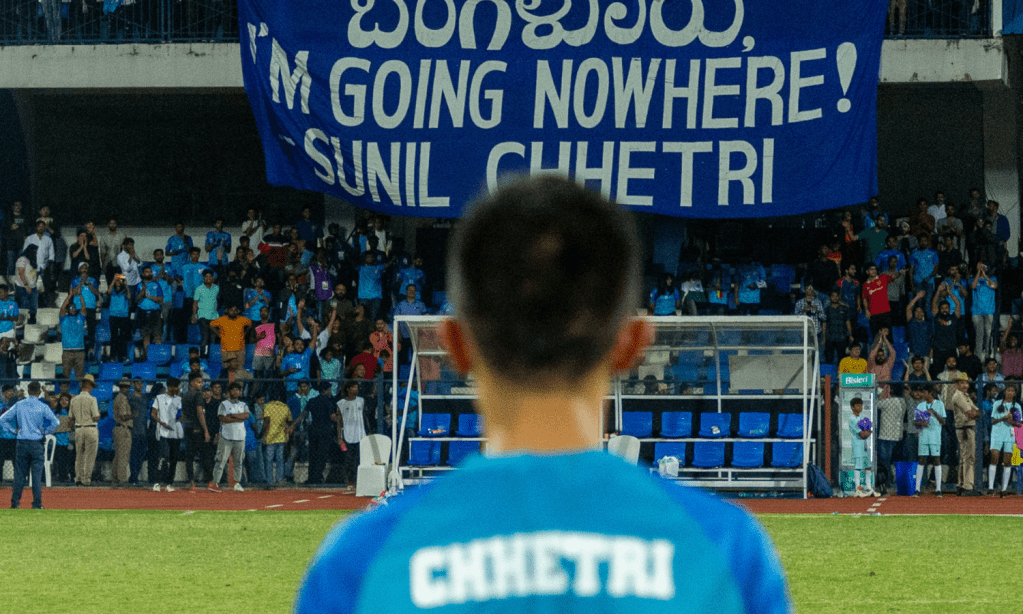
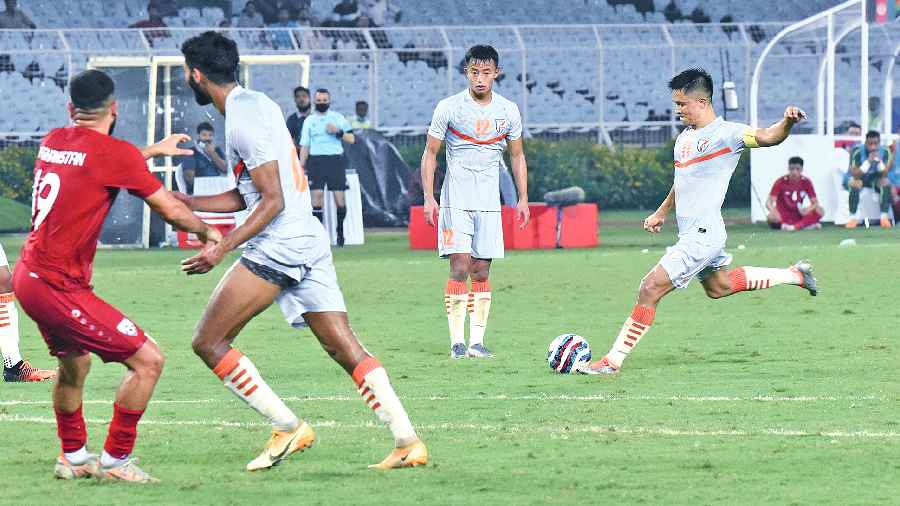
    That Sunil Chhetri free-kick, that helped India beat Afghanistan in the 2023 AFC Asian Cup Qualifiers. (Abhijeet 3001, CC BY-SA 4.0 <https://creativecommons.org/licenses/by-sa/4.0&gt;, via Wikimedia Commons)

    Sunil Chhetri, the Indian skipper, has helped turn the heads of football fans in India from Europe to their own country. In fact, he has turned heads worldwide for being the third highest active international goal scorer, behind only Cristiano Ronaldo and Lionel Messi. While his prolific goal scoring record has put his country on the footballing map (and football on his country’s map) that is only the tip of the iceberg when it comes to his contribution to Indian football.

    Chhetri is the perfect role model. His football career has been a bumpy road, but he has faced every obstacle with a smile on his face. Standing at 5 feet 7 inches, he was almost always the shortest player on the pitch. However, that has not stopped him from scoring dozens of headers in crowded penalty areas – a testament to his strategic positioning and athleticism. Now at 38 years of age, he is often the oldest player on the pitch. Yet, he is among the fittest players in his team. Chhetri is also a great communicator and leader, which you will recognize instantaneously when you hear him speak. Despite all his achievements, he is humble – never throws a tantrum or overly lauds himself. He always recognizes and gives respect to everyone who has helped him reach where he is today. For a country working hard to rise up the international ranks, India could not have been luckier to have Chhetri at the helm. Even without all those goals, the presence he carries on the pitch and in front of the public boosts the hopes and dreams of everyone involved.

    Chhetri’s career, as with many Indian footballers, started in the depths of an unstable, poorly marketed, and seemingly underground Indian first division. After a tryout, he signed with Mohun Bagan (one of India’s oldest and most renown football clubs), at the age of 17. In an interview, Chhetri said he expected to sign for the reserve team but was taken by pleasant surprise when he was asked to join the Mohun Bagan main team. During his first six years in the Indian top-flight, Chhetri scored 57 goals in 97 appearances. He also had good showings in the Santosh Trophy (a historic inter-state football tournament), which earned him a call up to the Indian team. His senior national team debut came in a friendly away to Pakistan, on 12th June 2005, where he scored India’s only goal in a 1 – 1 draw.

    Following all this success in India, Chhetri began to generate foreign interest. He was recommended by then national team coach Bob Houghton to several English clubs. The development of a move to Leeds United, who were in the English third tier at the time, was reported by The Telegraph, however that did not materialize. Estoril Praia, then in the Portuguese second division, were also keen to sign Chhetri but that too fell through.

    In the middle of the 2008-09 season, MLS clubs like DC United came calling but Chhetri chose to go to England once again and trial with Championship side Coventry City. After the trial however, the West Midlands side decided not to pursue their interest in Chhetri.

    Chhetri came back to India and finished out the season with East Bengal – scoring 13 goals in 26 appearances. In August of 2009, it was reported that Scottish giants Glasgow Celtic was linked to a move for Chhetri. However, later that month the Hindustan Times announced that Chhetri had signed a three-year contract with English Championship side Queens Park Rangers. This time Chhetri was denied the opportunity to play in England due to work permit complications. At the time, the British Government had two conditions that international players had to meet – the player must have played 75% of his national teams’ games, and his national team must be ranked top 74 in the World. Unfortunately for Chhetri, India was ranked 114. Chhetri and his representatives appealed this ruling in court, but they narrowly failed to win a majority.

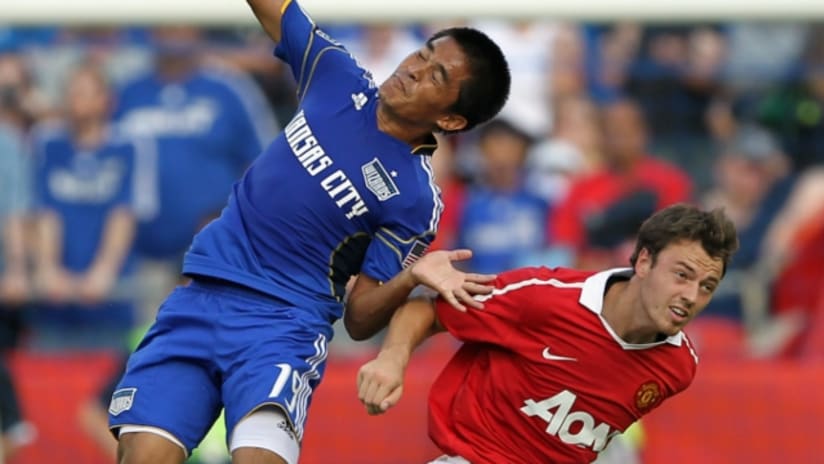
    Chhetri in action against Manchester United’s Jonny Evans, in a summer friendly in 2010. (Image via SportingKC)

    Despite the letdown, Chhetri maintained a positive attitude and had yet another strong goal scoring season in India. In the spring of 2010, Chhetri settled for an opportunity in the MLS and went on trial with the Kansas City Wizards. On 24th March 2010, Chhetri signed for the club and three weeks later he made his debut in the US Open Cup – thus becoming the third Indian born player ever to play outside of South Asia. Unfortunately, his first appearance was not impressive – he received a yellow card and was subbed off at half time. Chhetri failed to see any playing time in the league, but he was subbed on in a mid-season friendly against Manchester United which his team won 2 – 1 (a game that has certainly gone down in Indian footballing folklore). The next day, Chhetri left for international duty, which would last until the end of the 2011 Asian Cup (6 months away from Kansas City).

    The 2011 Asia Cup was India’s first appearance at a ‘major international tournament’ in 27 years. Even though India failed to win a single game in their group, Chhetri scored against South Korea and Bahrain – proving that he was still a clinical goal scorer when given sufficient opportunity.

    On 5th February 2011, in the build-up to the 2011 MLS season, it was announced that Chhetri had officially left the team. Chhetri’s stint with the Wizards was unsatisfactory to say the least, not helped by the fact that he was on international duty for six months. In recent interviews, Chhetri has said, “that’s the trip that I have the most regrets about” because he let his lack of playing time affect him, rather than motivate him.

    Back in India, Chirag United signed Chhetri for the rest of the 2010-11 season and the striker scored seven goals in as many games for the Kolkata based side. Chhetri moved across the city back to Mohun Bagan for the 2011-12 season and his performances continued to spark international interest. In July 2012, the striker finally had his breakthrough and signed a two-year contract with Sporting Lisbon. However, after one practice with the first team, Chhetri was sent down to play with the reserves – who competed in the Portuguese Second Division. Chhetri made three appearances for Sporting B, but he was loaned out to Churchill Brothers, back in India, so he could see more playing time. Chhetri went on to score four goals in eight games that season, which helped the Red Machine to their second ever I-league title.

    Following his release from Sporting Lisbon at the end of the 2012–13 season, Chhetri signed for Bengaluru FC – a newly formed club, entering into its first season in the I – League. Having bounced around various Indian clubs in the past, Chhetri had seen everything there was to see in Indian football. Therefore, he welcomed this new challenge in an effort to be a part of something new.

    Despite a slow start with his new club, Chhetri scored 14 goals (7 assists) in 23 games, leading BFC to the I – League title in their inaugural season. Following the 2013–14 season, Chhetri turned 30 and foreign interest began waning. Meanwhile, the domestic football scene in India was gaining prominence, with the creation of the well-funded and more ‘professional’ Indian Super League, which encouraged Chhetri to stay in India.

    Since then, Chhetri and BFC have risen together – winning two I-Leagues, one ISL, two Federation Cups, one Super Cup, one Durand Cup and becoming AFC Cup (Asia’s equivalent of the Europa League) finalists in 2016. Under his leadership, the national side has also seen incredible growth. As of today, the Blue Tigers are flirting in the high nineties of FIFA’s World ranking, a huge improvement compared to the 135th rank they held when Chhetri made his international debut in 2005. Having grown up in Bangalore in the last ten years, I can confirm that the 5-foot 7-inch forward is dearly loved in the Garden City and has single-handedly changed the footballing landscape in the country. He has given the people a local hero to look up to, a name for everyone to sing, and unparalleled footballing memories.

    Chhetri announced his contract extension to BFC supporters with a tifo of his own, following India’s SAFF Championship semi-final victory at the fortress last Saturday. (Image via AIFF)

    At the age of 38, Chhetri is still going strong for BFC, and more importantly for the Blue Tigers. He managed to find success in the Indian top flight, at a time when it was little known even within India. Despite his best efforts to play abroad, nothing quite worked out – mostly due to reasons out of his control. Having proved his superior ability in domestic Indian football, he has every reason to quit but he keeps coming back because he knows his value to the future of Indian football. As with the national team, he manages to score no matter his teammates, no matter the opponent. As a striker, it is easy to complain about not getting the right service, especially when playing for a relatively low-ranked team. But Chhetri is self-sufficient. He always finds a way.

    July 17, 2025
    Chhetri, Indian Football

  • QPR vs Birmingham City – a traditional English football experience

    (Originally published on June 19th, 2023)

    I am a Chelsea fan and going to a Chelsea game at Stamford Bridge is a bucket list experience for me. However, I failed to get reasonably priced tickets despite my best efforts. As I did my groundhopping research to prepare for my trip to London, people were harping on about how the ‘smaller’ London clubs offered a ‘traditional English football experience’ with great atmosphere. Meanwhile, London’s bigger Premier League clubs were known to have a more diluted crowd, owing to the number of tourists in attendance. Ultimately, it was a toss-up between Chelsea vs Everton for $120 or Queens Park Rangers vs Birmingham City for $25. Having been disappointed by the West Ham atmosphere the previous week and craving the ‘traditional English football experience’ I, rather disloyally, chose the latter.

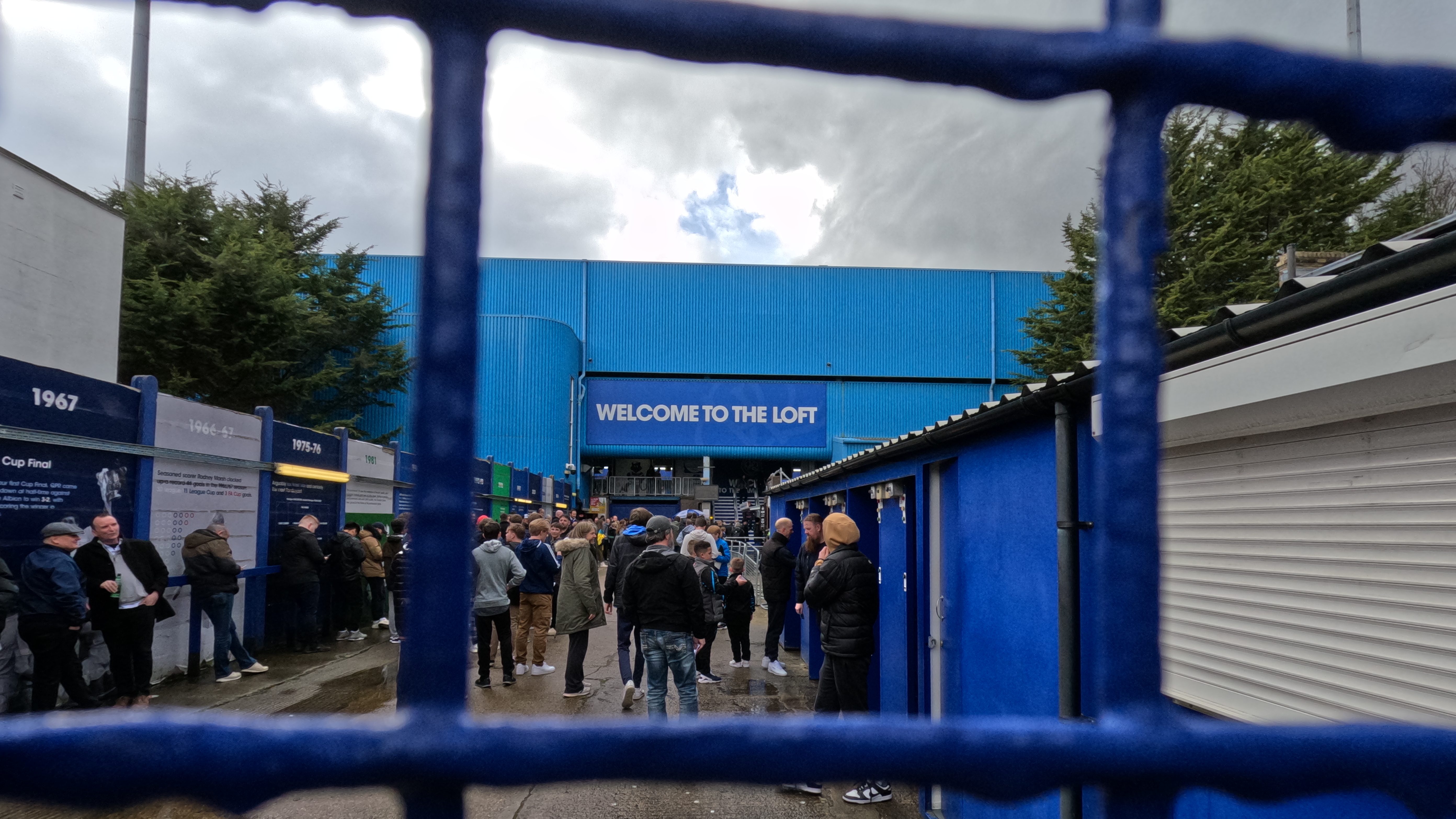
    An entrance to Loftus Road – might have mistaken it for a Decathlon or a godown, had I not known better.

    I was accompanied by my childhood friend Om and his friend from high school Adi for this one. We got off at Shephard’s Bush tube station, grabbed a snack from Tesco’s and walked down Loftus Road to the stadium. As we neared the place, we saw thousands of QPR supporters with blue and white scarves around their necks. We bought tickets in the ‘Loft Upper’, on the recommendation of the box office employees, before I got my customary scarf at the club shop.

    The stadium was boxed in on three sides by red-bricked town houses, so you would not even notice it, unless you were looking for it. As we entered the Loft and climbed the stairs to our seats, we could see into the backyards of all the houses on Ellerslie Road. Set in a working-class neighborhood, QPR is a club of the people – and you could tell from the second you turned onto Loftus Road. The whole stadium was made of blue metal sheets which gave it a make-shift appearance and seemed synonymous with the clamorous atmosphere it fosters. Inside, the pitch looked tiny, and from our seats, I felt extremely close to the field of play – almost as if I were on top of the corner flag.

    Despite the Hoops having won only one of their last fifteen games, the home support was very loud. The QPR hard-core were stood adjacent to us in the Ellerslie Road Stand which only amplified our experience. Unfortunately, the home side conceded within three minutes as former Manchester United youngster Tahith Chong tapped in from close range. The visiting Birmingham City fans celebrated wildly – to the point where a blue smoke bomb made its way onto the field.

    For the remainder of the second half, QPR did not look very impressive on the field. They struggled to string even five passes together and the fans were slowly losing their patience. Sam Field, the left center-back, tried repeatedly to play a long diagonal but lost possession every time. After the nth spell of scrappy possession, a man in front of us got up and yelled angrily, “who’s the leader your bunch of pricks!” As the half progressed the fans diverted their frustration to the referee and chants of “referee you’re a c7%$” began to ring out. By the end of the first forty-five, the atmosphere had died down considerably, and the players were booed off the pitch.

    Backyards on the left, the Stanley Bowles Stand on the right – this place really is in the heart of its neighborhood.

    At half time, my friends and I decided to explore the stadium and headed downstairs. The concourses were packed with people queuing up to buy a beer, so we hung out by the staircase that led up to the Loft Upper. Here, we came across a middle-aged man who gave us the run-down of being a QPR fan. Firstly, he prided themselves on being a ‘proper working-class club’, unlike Chelsea, Arsenal, and Spurs who are associated with wealthier backgrounds. He called QPR fans ‘Revolutionary Socialists’ while those of other London Premier League clubs as ‘Capitalists’. Chelsea, being a fellow West London club, was especially disliked by the QPR faithful. We heard anti-Chelsea chants throughout the game despite the two clubs being separated by a division and having not played each other since 2015. He said Fulham and Brentford supporters found them to be rather crude (in behavior) and were afraid to travel down to Loftus Road. Meanwhile, he informed us with a certain sense of satisfaction that QPR fans always travelled in numbers to Millwall, a club infamous for its hooligans. Finally, the conversation turned towards the misery of being a QPR fan with the club consistently finishing in the depths of the Championship (a contrast to the good fortunes of all their West London neighbors). Nevertheless, he was apprehensive about getting promoted to the Premier League because the consequent ‘cleansing’ may cost his club its identity. In the end, he told us how the club is like a large family – over the years, he has grown to know a majority of the people in the stands, and he has also met his closest friends through QPR games. We told him how we have been enjoying the raucous, unpolished atmosphere so far and he invited us to come out and support the club every other weekend.

    In the second half, the home side came out all guns blazing. They were constantly on the attack and got the crowd going again. Every corner, set piece, or even tackle won was applauded ferociously. QPR had several half chances to equalize early in the second half, but they failed to test Blues’ goalkeeper John Ruddy in any significant manner. At the other end, the visitors nearly converted their half-chance, in the 52nd minute, as Lukas Jutkiewicz’s header looked certain to sneak into the QPR net. However, Seny Dieng made a fantastic save to keep the Hoops in the game.

    This entertaining second half was only made more dramatic by a group of middle-schoolers who were stirring up trouble with a family in the Loft Upper. I do not think the specificities of that saga belong here, but it ended with the family leaving and one of the kids being kicked out of the stadium.

    The last ten minutes were extremely intense as QPR were banging on the door for the equalizer. Just as advertised, it got loud and clamorous. The Hoops were winning corner after corner and trying desperately to put the ball in the net. The best chance fell to Landon Dykes at the second post, after a low cross missed everyone in the middle. Unfortunately, the Scottish international could not quite get it out of his feet and ended up missing with a tame effort – you could feel the disappointment in the air. Meanwhile, Ruddy was exceptional in the Blues goal, collecting cross after cross, which did not help QPR’s cause.

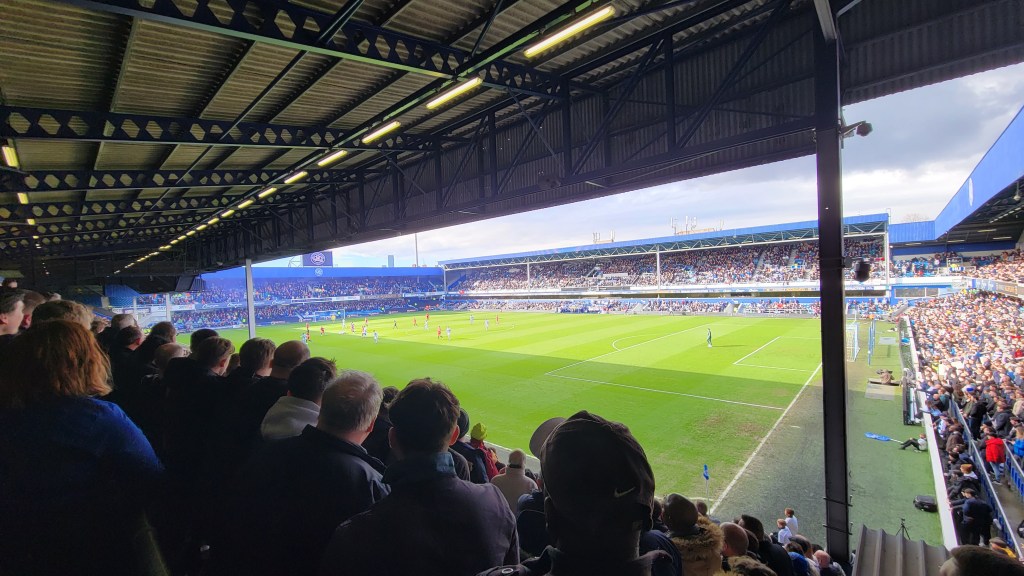
    Our view of the game from our seats in the Loft Upper. For those wondering, the pole bothered me as much as it is bothering you right now – for NINETY minutes.

    Towards the waning moments of the game, I was pressurized by those trouble-making kids to start a chant. At this point, an equalizer looked unlikely and the mood in the stands was not positive. It was not the time to sing “Gareth Ainsworth’s Blue and White Army” or “Allez allez allez O, QPR FC.” So, I chose an opportune moment, when the referee gave a free-kick against QPR, and yelled “you’re not fit to referee.” Within moments, it caught on in the Ellerslie Road stand, then in the Loft, and soon the whole stadium was singing it (I will proudly talk about it for the rest of my life).

    Ultimately, the equalizer did not come, and the full-time whistle was accompanied by series of boos, which quickly turned into chants of “sack the board.” Even though we visited QPR during a difficult run of form, and watched an agonizing defeat, it was an incredible atmosphere and a great experience. There were no tifos or drums or jumping but I felt so involved and did not zone out of the action for even a second. Like everyone around me, I stood for ninety minutes, despite having the option to sit, and lost my voice – essentials for a good Saturday afternoon at the footy. As for Loftus Road Stadium, it is not the most attractive or comfortable ground in the World, but it has a certain charm that I would want to return to every other week.

    July 17, 2025
    Birmingham City, EFL Championship, QPR

  • Swiss Football: An anomaly to Swiss Society

    (Originally published on July 2nd, 2023)

    When you think of Switzerland, you think of pristine lakes flanked by green hills and tremendous Snow-capped mountains. You think of chocolate and cheese, and wealthy bankers hustling in expensive suits to work. You think of Swiss watches and precise, efficient public transportation. If I were to describe the country in four words (before I visited), it would have been – beautiful, civilized, boring, and expensive. While all this is true, Switzerland, like every other country, has more than one side to the picture.

    ‘The other side’ is characterized by haphazard graffiti on city-walls and copious amounts of cigarette smoke in the air – absolutely nothing wrong with this but it does not rhyme with the outsider’s vision of the alpine nation. However, nothing epitomizes the ‘other side’ of Switzerland more than domestic Swiss football.

    Football clubs in Switzerland have not really turned heads in European competition in recent years. While teams like FC Basel and BSC Young Boys have had good showings, they have come in preliminary rounds, which do not garner as much attention Worldwide. Furthermore, the television coverage rarely gives you a good idea of the events in the stadium. Hence, there is a sort of mystery surrounding Swiss football and people do not really understand the football culture here.

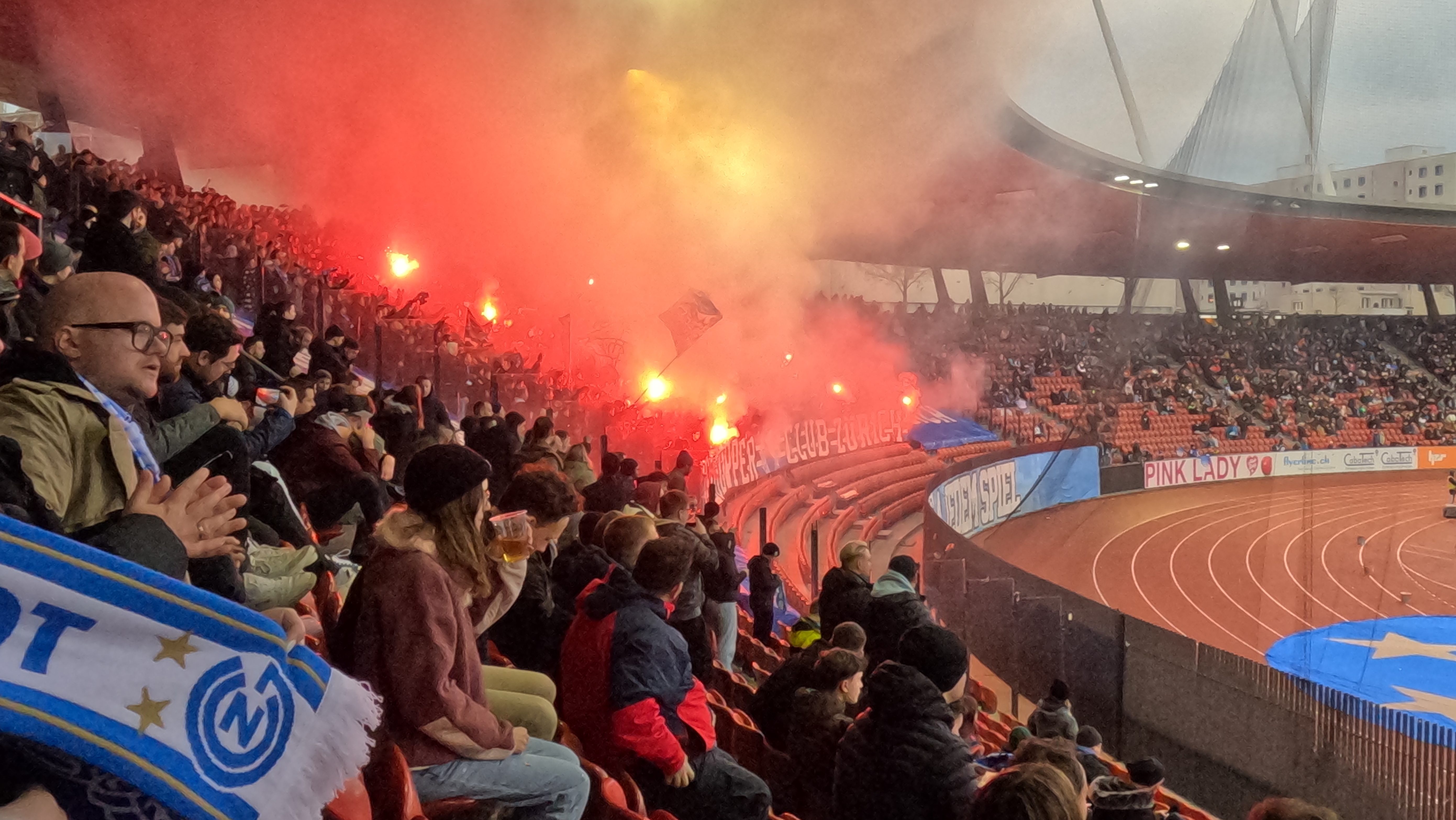
    Pyroshow in the Grasshopper Club Zurich end, ahead of the Zurich derby on February 19th, 2023.

    To start off, club football in Switzerland is dominated by the ultra scene. Being wedged in between Italy, Germany and France, the influence of these countries does not fail to extend to football fandom. Ultra culture in Europe is said to have originated in Italy and football supporters in Germany and France have taken it to another level. When you are surrounded by such a demographic, you are bound to pick up some good (and not so good) tendencies.

    Having spent four months in Switzerland, I was able to attend six top-flight games and I can assure you the stadium experience is extremely unique and mind-boggling. For example, Servette FC (a club I frequented and grew an affection for during my time in Switzerland) receives an average attendance of under 9000 in their 30,000-seater stadium. However, their ultra group Section Grenat, who are always present, produce enough noise to make up for the empty seats. At one end you have the Tribune Sud that remains closed to the public due to the lack of demand, while the other end is filled with ultras who impress with pyro shows, choreos and sing all game long.

    In the German side of Switzerland, clubs receive better crowds – St. Gallen, Winterthur and Young Boys nearly sold out their stadiums every game this past season. Anyone who is familiar with Swiss football will tell you that Swiss-German Ultras can more than compete with their German counterparts. Ultras of FC Zurich, Young Boys, Basel, and Luzern have gained a reputation for tremendous tifos, intimidating corteos and overall incredible support. However, they are also known to be quite notorious, making headlines in numerous infamous fan incidents.

    A massive tifo unveiled in the BSC Young Boys supporter section as the players are about to walk onto the pitch.

    For instance, in 2016, FC Zurich’s relegation to the second division was confirmed on the final day of the season. The Zürcher Südkurve (FCZ Ultras) were not impressed and hundreds of individuals, dressed in black jackets and ski masks stormed the players’ tunnel after the final whistle, demanding a meeting with the board. Similarly in 2019, when Grasshopper Club Zurich were losing 4 – 0 to Luzern – a result which would see them get relegated from the top-flight for the first time in 68 years – their supporters threatened to storm the pitch and forced their players to hand them their shirts. The game was consequently called-off and GC went down.

    No one was injured in either of these incidents, but it clearly put the safety of players and club staff at risk. While this is not the right way to go about things, you can see the power football supporters have in matters regarding their club in Switzerland. If they feel the players are not ‘fit to wear the shirt’, they demand it back. If the club’s future is in jeopardy, they force a meeting with the executives. Nonetheless, it is amusing how riotous football supporters can be, in what we assume to be a ‘peaceful’ and ‘ordered’ Swiss society (I wonder if the United Nations knows).

    However, this is not all. There are so many ugly incidents involving football supporters in Switzerland. The most infamous of them all must be what is now referred to as ‘The Disgrace of Basel’. On the 13th of May 2006, FC Basel hosted FC Zurich in the final match of the 2005-06 season. Basel were at the top of the table, three points ahead of second placed FCZ. If Basel won or drew the game, they would be crowned champions of the Swiss top-flight. However, if FCZ won, the two teams would be tied on points and the visitors would become champions owing to their superior goal difference.

    The game kicked-off in a packed St. Jakob Park. The visitors took the lead in the 30th minute, but the hosts equalized in the 72nd. At the 90th minute mark, it was still 1 – 1 and the Basel faithful were preparing to commence celebrations. However, in the 90 + 3rd minute, the ball fell to FCZ’s Iulian Filipescu just outside the six-yard box, and he diverted it into Basel’s net. The referee blew for full-time immediately after the game restarted and the FCZ players, and their travelling fans began their euphoric celebrations (some spilling over onto the field). Meanwhile, a disappointed group of Basel supporters invaded the pitch and began attacking the FCZ players. The police formed a line near the center of the field, to prevent the Basel hooligans from advancing andto keep the two sets of supporters from clashing. Once the police gained control inside the stadium, the melee continued outside – and it went on late into the night. Ultimately, 115 people were injured and 15 were hospitalized.

    While all these events may seem like myths and rare occurrences, triggered by the most dramatic circumstances, I can assure you conflicts are quite frequent. I personally witnessed FCZ fans square off against the Geneva police after a Wednesday night fixture between FC Zurich and Servette FC. I do not know how the situation escalated – maybe the police were at fault (people rarely consider that) – but a brawl did occur.

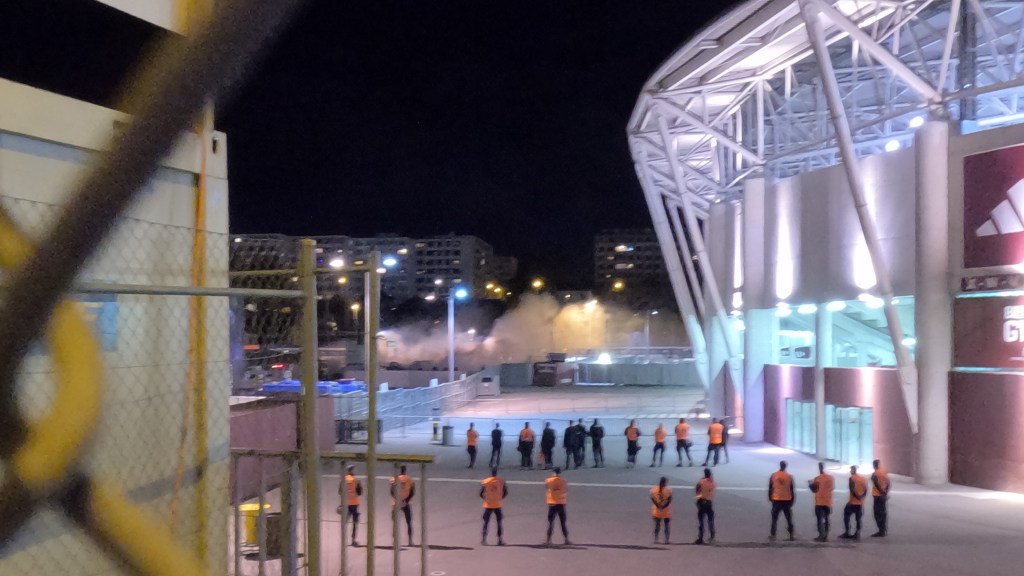
    A cloud of smoke arises as FC Zurich supporters clash with the Geneva police outside the away section at Stade de Geneve.

    Another blatant contrast between Swiss football and society features Swiss trains. Trains in this country, along with its other forms of public transport, are known to ‘work like clockwork’. They are said to be punctual and efficient, while boasting scenic views. The inside is usually very civil, with professionally attired men and women typing away on their laptops or quietly answering phone calls. However, the SBB designated train that takes ultras, and more casual supporters alike, to away games is remarkably unlike a standard commuter train. It looks ordinary enough from the outside, but on the inside, it is unlike anything you have been in. I was fortunate enough to return from Bern (after watching Servette play Young Boys) on one of them and I had the time of my life – despite the stench of cigarettes and beer. In one compartment people were singing Servette songs, in another it was French rap, and in the third the lights were dimmed, and it was transformed into a night club. Men were chasing each other with fire extinguishers, Section Grenat stickers were being stuck on the walls – it was a vibe.

    However, I kept getting told that the train to an away game is more fun. In a video I came across on the internet, a Servette supporter was showing off the ‘menu’ on offer on one such train – two guys were stirring up fondue in a Section Grenat branded pot, while another fan was making fresh sandwiches in a portable panini maker. What better way to travel to the football (The SBB officials would be horrified if they knew).

    Personally, I am not one for luxury watches or Swiss army knives. I hate wearing suits and I know nothing about finance. I am not always on time, and I am terrible at skiing (even if I manage to afford it). However, I do love football: I love vocal supporters, pyro, tifos, and forming relations around the beautiful game. Some of my most memorable football experiences (and Swiss experiences) have involved Swiss football. I relished every moment in the Tribune Nord of Stade de Geneve – from my first visit when I was dumbfounded by the firework show in the away section, to the many games I spent jumping and singing with the Servette Ultras. Club football in Switzerland could not be more unlike stereotypical Swiss society, and that is just what I love about it.

    (Also, I just wanted to make it clear that I do not stand for hooliganism or violence at football games).

    July 16, 2025
    Swiss Super League, Switzerland

  • West Ham vs Aston Villa: My London Stadium Experience

    (Originally published on April 26th, 2023)

    During my time watching football, I have followed the Premier League the most religiously. In fact, I have only really followed the Premier League. So, when I decided to study abroad for a semester, I planned a visit to the UK for my mid-semester break (my longest break) so I could catch as much Premier League (and other English football) action as possible. Unfortunately, Premier League tickets are hard to come by and it seems to be virtually impossible to get tickets for my beloved Chelsea (even as a member). So, I decided I would go to any game that I could get tickets to and West Ham’s home tie against Aston Villa ended up being the easiest one.

    A part of the Bobby Moore exhibit on the John Lyall gates, now installed in the West Ham club shop.

    I was extremely excited for this game, having grown a soft spot for the Hammers from watching Spencer FC’s ‘West Ham Vlogs’ back in the day. In the past 5-6 years, West Ham have had many players who have done extremely well for my fantasy team (Dimitri Payet, Felipe Anderson, Jarrod Bowen, and Michail Antonio to name a few) which gave me all the more reason to support them when they played anyone but Chelsea. I also happen to know ‘Bubbles’ by heart, so I was eager to belt it out as the players walked onto the pitch.

    So, with all this in mind, I arrived at the Olympic Park a good 90 minutes before kick-off. Getting off at Stratford tube station, I walked with thousands of West Ham fans across the bridges to the massive bowl-shaped London Stadium. Before entering the seating area, I made a quick stop at the club shop, and saw a very cool Bobby Moore exhibit – The John Lyall Gates, entrance to the former Boleyn Ground, are now installed in the club shop and there were newspaper clippings and scarves hung up to pay tribute to Bobby Moore (West Ham legend and 1966 World Cup Winner).

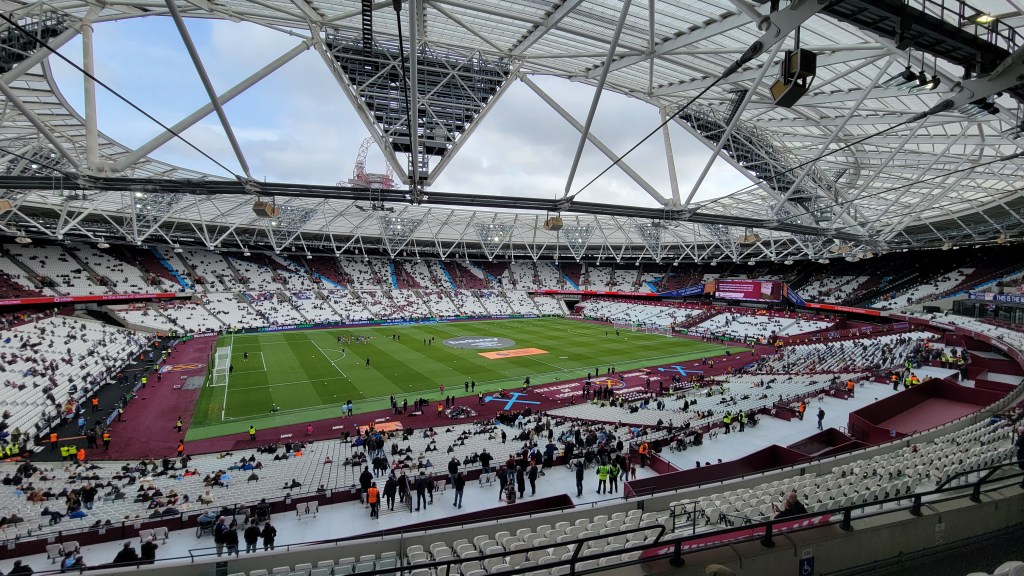
    I entered the stadium with about 45 minutes to kick-off and the stands were mostly empty. I watched Alphonse Areola warm up at one end and World Cup winner Emi Martinez at the other. Looking around the stadium from the inside sparked numerous thoughts in my head. Everyone who knows anything about West Ham knows they had a tearful move from their former home – the old, compact, traditional Boleyn Ground – to the modern, large, and not necessarily fitted for football Olympic Stadium. From inside, I could see all the haphazard adjustments that were made to the make the stadium compatible for English football. There were temporary stands installed in three of the four sides and a walkway connected the original stand to the temporary ones, with a large wasteful gap in between.

    With about 10 minutes to kick-off, the stands began filling up rapidly and it was soon full (barring a few empty seats here and there). Over the speakers, an announcement was made to create awareness regarding male cancers – in memory of Dylan Tombides (a West Ham youth player) who passed away seven years ago this week, due to testicular cancer. We were also informed about DT38, a foundation created by Tombides’ family, that aims to change the way testicular cancer is diagnosed.

    As the players finally began walking onto the field, a familiar tune began playing over the speakers and bubbles were flying everywhere. I joined in with 60,000 odd West Ham Fans and sang ‘I’m forever blow-wing bubbles’ at the top of my voice.

    Once the game kicked off and the West Ham fans had finished singing ‘Bubbles’ twice, the London Stadium went silent. For the next ten minutes, all I could hear were the travelling Villa fans, who occupied a corner of the Trevor Brooking Stand.

    Look at the large walkway connecting the temporary stands below to the permanent stands – it really distances the fans from the action.

    On the pitch, however, the Hammers were all over Villa. They had a couple of half-chances early in the game, but they could not capitalize off any of them. The visitors, on the other hand, scored off their first significant attack in the 17th minute. Some lackluster defending allowed Álex Moreno to pick out Ollie Watkins in the middle, and the English striker nodded in the opening goal of the game. Knowing how West Ham’s domestic season is going, the circumstances surrounding the goal seemed quite apt, and frustrating.

    Luckily, West Ham did not ease off the pedal and in the 25th minute, Lucas Paquetá earned them a penalty after being shoved down in the box (it was a soft one, but it was given). Saïd Benrahma stepped up to take it and he rifled it into the top corner, past the outstretched arm of Emi Martinez. The Algerian ran over and shushed the travelling Villa fans before being embraced by all his teammates.

    From my vantage point high up on the terraces, I was able to really appreciate the quality of football that was on offer. West Ham were playing expansive football, with good spells of possessions and daring build ups – something that has been a characteristic of Premier League football in recent years. Obviously, the Hammers were not perfect, and they lost the ball cheaply on multiple occasions, but it was still a good watch. Villa preferred to sit back and absorb the pressure, before finding opportune moments to hit West Ham on the counter.

    In the 31st minute, West Ham got a chance very similar to the one Villa scored. Benrahma whipped in a cross into a crowded penalty area, but an unmarked Kurt Zouma headed wide. With a few minutes left in the half, Moreno got forward once again and continued to cause problems for West Ham. He slipped in a ball to Jacob Ramsey, who squared it to Watkins, but Alphonse Areola made a huge save to prevent Watkins from having a second. Heading into the break, the two sides were level.

    I must say I found the home crowd to be quite tame. Apart from giving Emi Martinez plenty of stick for alleged timewasting, singing bubbles and yelling ‘Come on you Irons’, they offered absolutely nothing. A majority of the supporters in my section (and the entire stadium it felt like) were older fans or parents with kids, who did not actively involve in any of the songs or heckling.

    After the break, Villa controlled possession, but the Hammers were more threatening. In the 56th minute, Benrahma cut inside from the left wing and unleashed a curler that seemed destined for the back of the net. However, Emi Martinez made an incredible fingertip save to push it over the bar. Over the course of the second half, the home side continued to apply the pressure and create chances. The West Ham crowd were more active now, as they applauded every tackle, through ball and corner with fervor. Unfortunately, the end product was lacking for the Hammers, and they squandered many half-decent opportunities.

    In the later part of the second half, the intensity of the game began to decline, and a stalemate seemed imminent. However, this was only a calm before the storm because it really picked up in the last few minutes. In the 84th minute, the ball fell to Benrahma at the back post, but he was denied from point-blank range by a superb last-ditch tackle from Ashley Young. A few minutes later, Villa nearly scored from a deflected corner, but the ball eventually fell into the grateful arms of Areola. Finally, in the second minute of injury time, Maxwell Cornet was played through on goal with the chance to score a West Ham winner. However, Martinez made the save, following which the off-side flag went up.

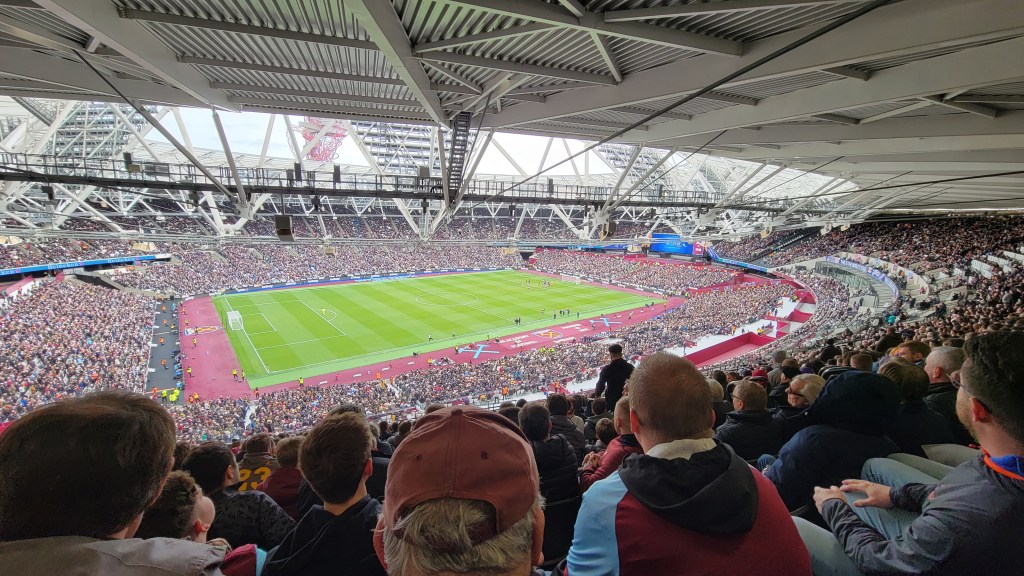
    My view of the game, slightly exaggerated in this wide-angle shot. Honestly, it was not bad at all and I could see everything that was happening on the pitch.

    In the last few seconds of injury time, there were at least a couple of very realistic full-time whistles from the crowd, which I thought was funny. Several people around me stood up thinking that was that, and I nearly did so myself. Finally, when the referee blew his whistle, boos echoed around the stadium, showing the dissatisfaction of the home support. Personally, I thought West Ham performed quite well and were unlucky with the result. However, considering that they are just one point above the drop zone, I can understand the frustration.

    Looking back, it was a very interesting experience. Everything felt ‘sanitized’, so unlike the Upton Park West Ham (that I saw in Spencer FC’s vlogs). In every conversation I had at the stadium, I was asked (in a friendly manner) whether I was a West Ham fan, or if I was just trying to catch a Premier league game. I guess the West Ham faithful have accepted the fact that ‘tourist fans’ are an unavoidable consequence of ‘growing the club’. If any West Ham fans are reading this, you might feel better in knowing that I sang every song as loud as I could and tried my best to contribute to the atmosphere.

    Finally, I left the Olympic Park, to the sound of drunk Villa fans singing, “stick your f#$!king bubbles up your a#$e” – which somehow seemed to be a fitting end to a matchday at the Olympic Stadium.

    July 15, 2025
    Aston Villa, English Premier League, West Ham

  • OGC Nice vs AJ Auxerre: My Allianz Arena Experience

    (Originally published on April 16th, 2023)

    When people think of the South of France, they think of the beaches, the sparkling blue waters and the warm climate. Football in the French Riviera often gets overlooked, but I made sure I gave it a chance.

    OGC Nice are one of the two top-flight teams on the Cote d’Azur (the other being rivals AS Monaco). Formed in 1904, they were one of the founding members of the French first division. The club has had its share of success – with four league titles and three cups – however, their last major win came way back in 1997. At present, Les Aigons (the Eaglets), as they are nicknamed, are back on the rise, being regular competitors for a spot in Europe.

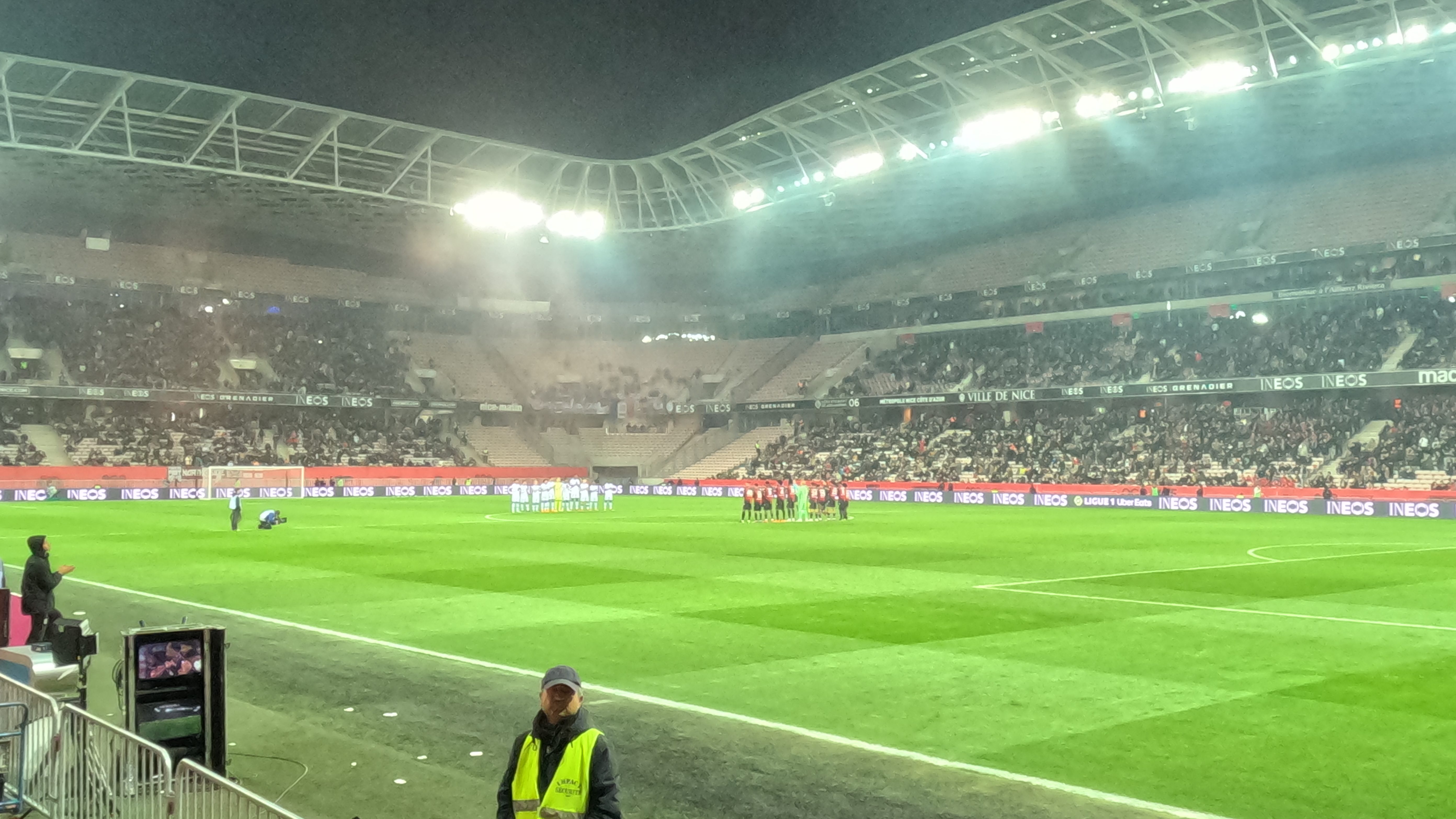
    The view from my seat, as players from both teams line up before kick-off.

    When I visited, Les Aigons were hosting relegation threatened Auxerre, in a late Friday night kick-off. I was not sure what to expect in terms of atmosphere however, I was excited to watch Kasper Schmeichel (one of my favorite goalkeepers) and I could not turn down the 10 Euro student tickets. When I reached the Allianz Riviera, about 2 hours before kick-off, I could not see any sign of the Nice Ultras, however, I did see some pre-match activities outside the stadium. There were plenty of carnival style booths, with games like teqball, foot-tennis, robo-keeper and foot-darts. Mixed in between them were food stands selling hot dogs and burgers. I know it is not quite the same, but it reminded me of an American tailgate, where people gather ahead of game time to grill up some food and play backyard games.

    When I entered the club shop for my customary scarf, I was in for a pleasant surprise – the 2020-21 OGC Nice shirt was on clearance for Euros 30 (and they even had my size). A team kit for this price tag was a no-brainer for me so I left the boutique with my hands full.

    Having no one to play teqball, or foot-tennis with outside the stadium, I decided to head in and see if there was anything interesting going on in there. When I walked in, the Auxerre players were doing their pitch inspection – unfortunately I could not recognize any of them. A few minutes later, the Nice goalkeepers, including Schmeichel, came out to warm up. My seats were pitch-side, at one end of the Ségurane stand, so I was able to watch Schmeichel’s full warm-up from about fifteen feet away – it was great! I met some teenagers from Denmark, who were trying to gain Schmeichel’s attention with a massive Danish flag. One of them was eager to talk to me so I chatted up whatever I knew about Danish football and learnt a little bit about Brøndby (his team).

    As we got closer to game time, the Populaire Sud, which seats the Nice ultras, began to fill up and it was packed in time for kick-off. The Auxerre supporters sat in the opposite corner while the other stands were partially filled.

    Prior to kick-off, there were still plenty of pre-game festivities in store for us: Swiss International Yordon Lotombo was making his 100th appearance for les Aigons so he was presented with flowers and a framed shirt to commemorate the event. Then, Nice’s mascot – Mèfi the eagle – flew around inside the stadium, to the applause of everyone in attendance (I do not think animals should be trained like this for human entertainment).

    The first half started out as an end-to-end affair, but Nice gradually established possessional dominance. The visitors, however, were content with sitting back and hitting Nice on the counter.

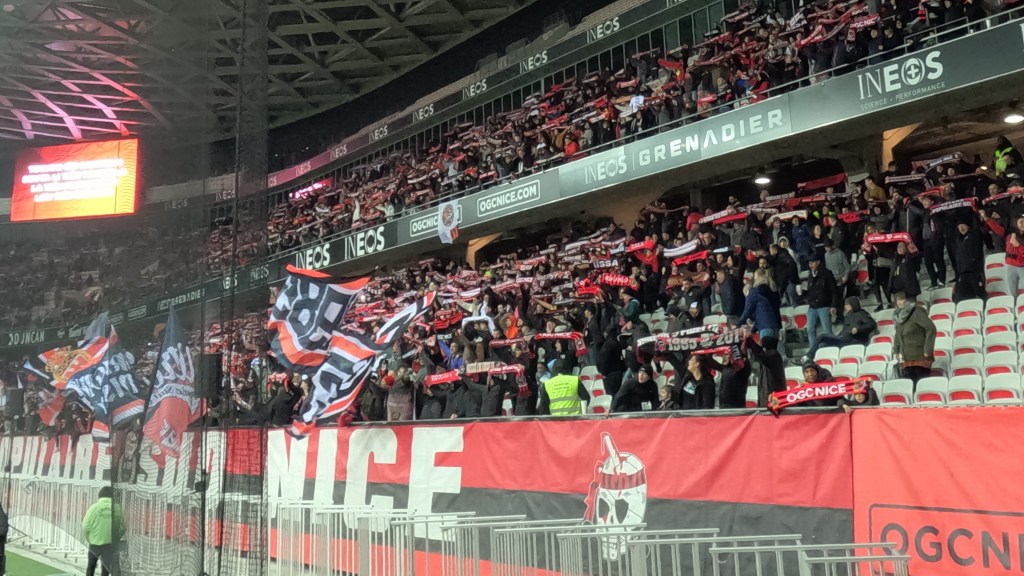
    Supporters in the Populaire Sud holding up their scarves and singing Nissa la Bella – the unofficial anthem of the city of Nice.

    In the 36th minute, Auxerre broke the deadlock, against the run of play, and I had front-row seats to watch the crazy wing play that led to the goal. Matthis Abline checked back to receive a pass from his center back, but seeing Dante follow him he let the ball roll and ran in behind. He then outmuscled the veteran center back – completely ruining him – before cutting it back to Gauthier Hein who finished through the legs of Schmeichel. It was quite an embarrassing goal for Nice to concede, right in front of the Ultras Populaire Sud, and Dante and Schmeichel were made to look silly.

    Six minutes later, Nice were awarded a penalty for a blatant shirt tug on Khéphren Thuram and Les Aiglons had the opportunity to make their dominance count. Gaëtan Laborde stepped up to take it and he smashed it straight down the middle. Unfortunately for him Auxerre’s netminder, Ionuț Radu, held his ground and made a fantastic reactionary save.

    Nice continued to push for an equalizer and they eventually succeeded in the dying seconds of the first half. Jordan Lotomba got a yard on his man before whipping in a cross that found Laborde, unmarked by the penalty spot. This time the Frenchman did not faulter as he found the back of the net with a diving header.

    Despite the turbulent first half, the Ultras Populaire Sud maintained their loud support for les Aigons. The fans were more reserved in my section and in most other parts of the ground (‘mere spectators’ as I would call them). In fact, there was a pair of Auxerre fans sitting right behind me, unopposed. So, with the help of a Nice faithful, that the Danish guys introduced me to, I moved away from my pitch side seat and got in with the Ultras Populaire Sud for the second half.

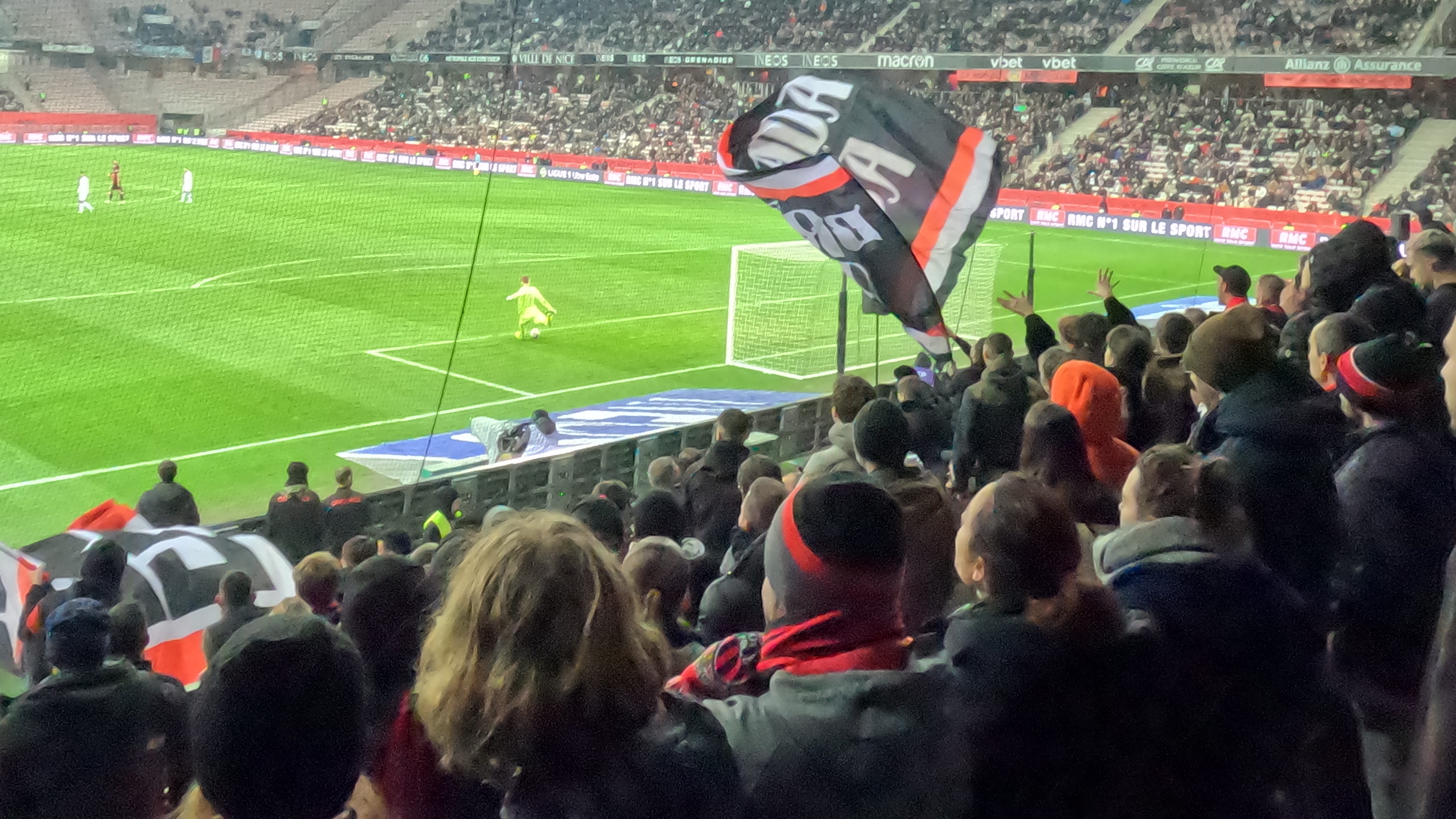
    My view amidst the standing crowd in the Populaire Sud Tribune, as Auxerre’s Ionuț Radu takes a goal kick.

    I decided to stand towards the edge of the Populaire Sud tribune where the vocal casuals merged with the ultras. The place wreaked of cigarette smoke and alcohol, but I knew it was better than being a ‘mere spectator.’

    Nice were on the attack for pretty much the entirety of the second half. In the 59th minute, they came close to scoring after a lovely interchange of passes, but Hicham Boudaoui’s drive was denied by a spectacular fingertip save from Radu.

    Auxerre were hanging on by a thread but no matter what les Aigons did they could not find the elusive winner. In the last few minutes, it felt like the hosts had at least a dozen corners and half as many free kicks, but the net in front of us simply would not bulge.

    At this point the group of supporters immediately next to me were quite drunk. Whenever we tried to ‘huddle’ and jump together (in conjunction with the rest of the stand), they would lose balance, and everyone would go down like dominoes – it was a good time. However, I did feel the energy in the Populaire Sud was waning a little bit and a timely last-minute goal could have changed all of that. Unfortunately for the Nice hardcore and I, that goal did not come, and I did not get to experience the limbs at the Allianz Riviera.

    Sitting high up in the terraces can be great to see the tactical side of the game but I enjoyed the rare opportunity of sitting pitch-side as I got a real feel for the intensity of the action. It is mind-blowing how fast, strong and powerful these players are. When up close, you can see how effective even the smallest body-feint or drop of the shoulder can be, to get past your opponent. Anyways, Auxerre managed to score off their only shot on target and walk away with a crucial point. On the other hand, OGC Nice will be disappointed with the result, but they did manage to extend their unbeaten run under head coach Didier Digard to nine games.

    July 15, 2025
    Auxerre, Groundhopping, Ligue 1, Nice

  • Olympique Lyonnais vs Grenoble Foot 38: My Groupama Stadium Experience

    (Originally published on April 5th, 2023)

    If you have read any of my previous groundhopping blog posts, you probably know that there is a running theme of me being late to the football. For this trip to Lyon, my friend Anthony (fellow groundhopper and study abroad classmate) and I took it to another level – we barely even made it to the city. We were due to board the 4:42 PM train to Lyon, from Geneva, but we only left our apartment at 4:25. After a mixture of running and bus hopping, we made the train in the nick of time.

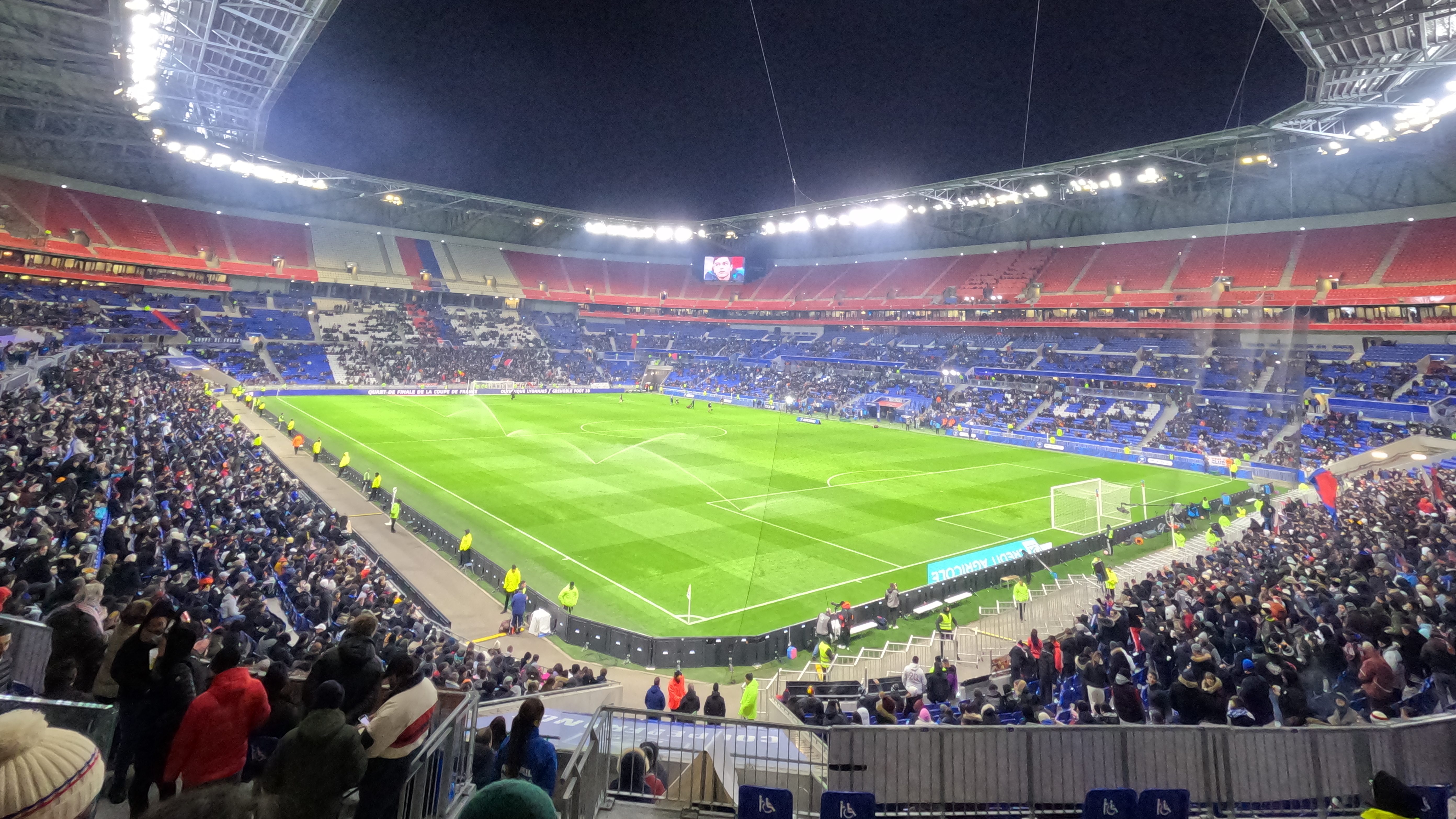
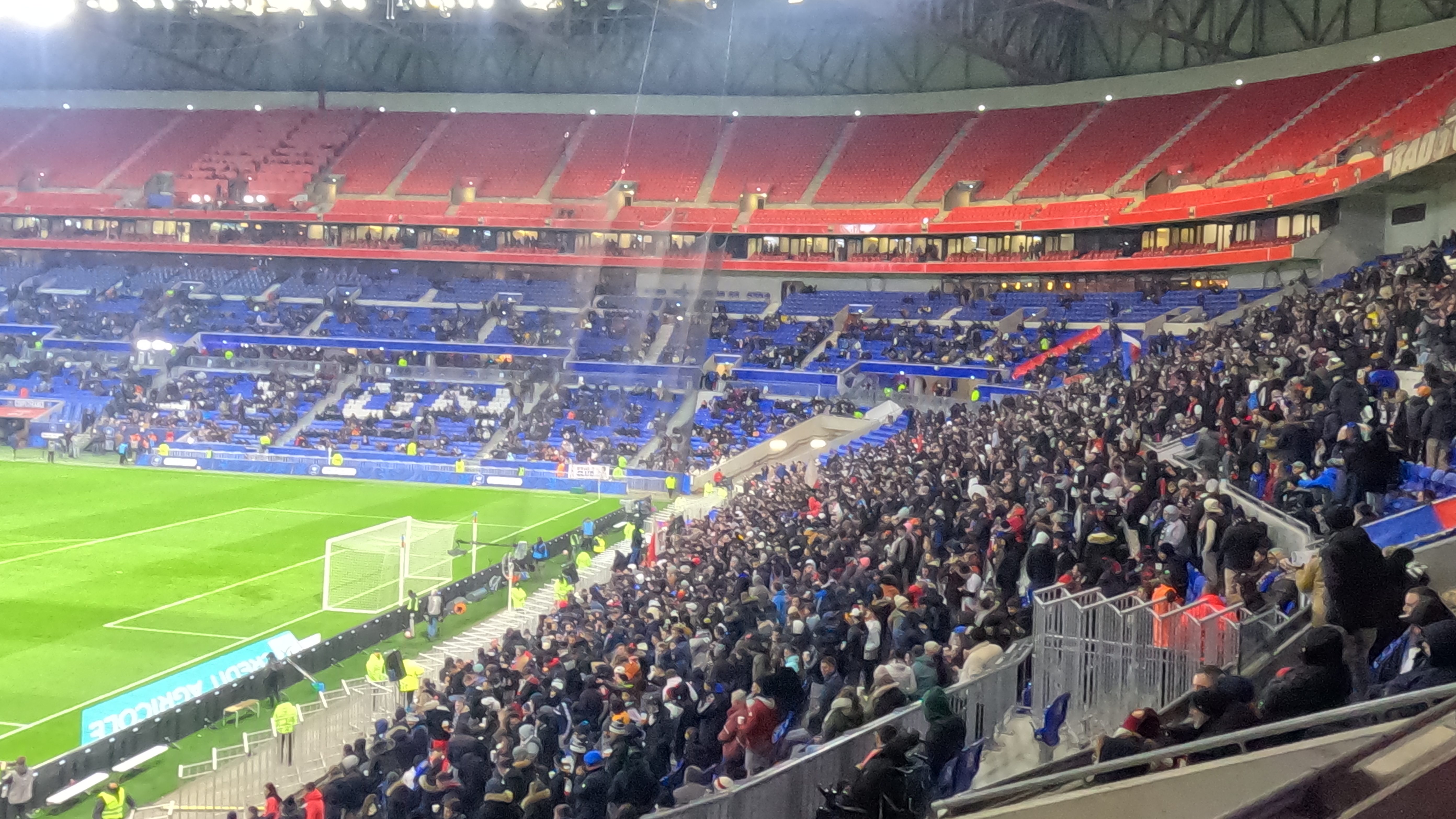
    Our view of the pitch, from the corner between the east and south stands.

    Lyon is only two hours from Geneva, so it provided us with the perfect opportunity to watch Olympique Lyonnais play midweek. OL’s Coupe de France (French Cup) quarter final against nearby Grenoble Foot 38 proved to fit our schedule best so we took off for the French city as soon we got out of classes on that particular Tuesday.

    Fast forwarding past the commute, we arrived at Groupama Stadium with about 45 minutes to kick-off – not so late after all. Completed for the Euros in 2016, the stadium is a typical modern multimillion-dollar sporting arena – not unlike an NFL stadium in the US – with connected stands and continuous seating. The large three-tiered structure loomed large over the surrounding apartments and its brilliant lighting made it stand out in what was otherwise a quiet suburban neighborhood.

    The OL fan shop was waiting for us at the main entrance, and I got a Lyon scarf with the entire OL anthem sewn onto it – decent! A lot of the clothing in the shop reminded me of PSG merchandise – designed to be ‘fashionable.’ This is definitely common with American Sports teams, but it is not something I felt with any of the other football club shops that I have visited so far in Europe (an interesting difference in culture?).

    When we got into the stadium, the players were warming up, so I was able to catch some of that. I had not eaten anything since lunch, so I got myself a pizza at one of the concourse food stands, before moving to our seats in the corner between the ouest and sud stands. I noticed that the OL ultras occupied the sections behind both goals. The ultra supporter group Lyon 1950 sat adjacent to us in the Virage Sud (South bend), while the Bad Gones occupied the opposite Virage Nord (North bend). Meanwhile, the away fans sat high up in a corner to our left, far away from the action. Just before kick-off, the floodlights were dimmed, and a spectacular light show ensued. The Grenoble fans took the opportunity to light pyro, and if you did not know already, pyro and darkness are a match made in heaven. For a 9.10 PM kick-off on a Tuesday night, the pre-game festivities surpassed our expectation by some margin.

    Being a mid-table Ligue 2 team, Grenoble were bossed by Lyon (possession-wise at least) for the majority of the first half. However, the visitors – through their very direct, counter attacking approach – did create a few chances. In the 5th minute the ball was lumped forward and found its way to the feet of Grenoble’s skillful winger Matthias Phaëton. He took his defender on and fired a shot, but it was well saved by Anthony Lopes.

    In the 24th minute, OL’s dominance bore fruit as their 20-year-old winger Bradley Barcola found the net with a perfectly guided flick header. The goal sent the crowd around us into a frenzy, but Anthony took it a little far by grabbing this kid’s jacket and ripping it (unintentionally, while celebrating). The kid immediately gestured to us that he wanted monetary compensation. The elation of the goal died away as we realized that we were in for a long awkward 60 minutes plus halftime.

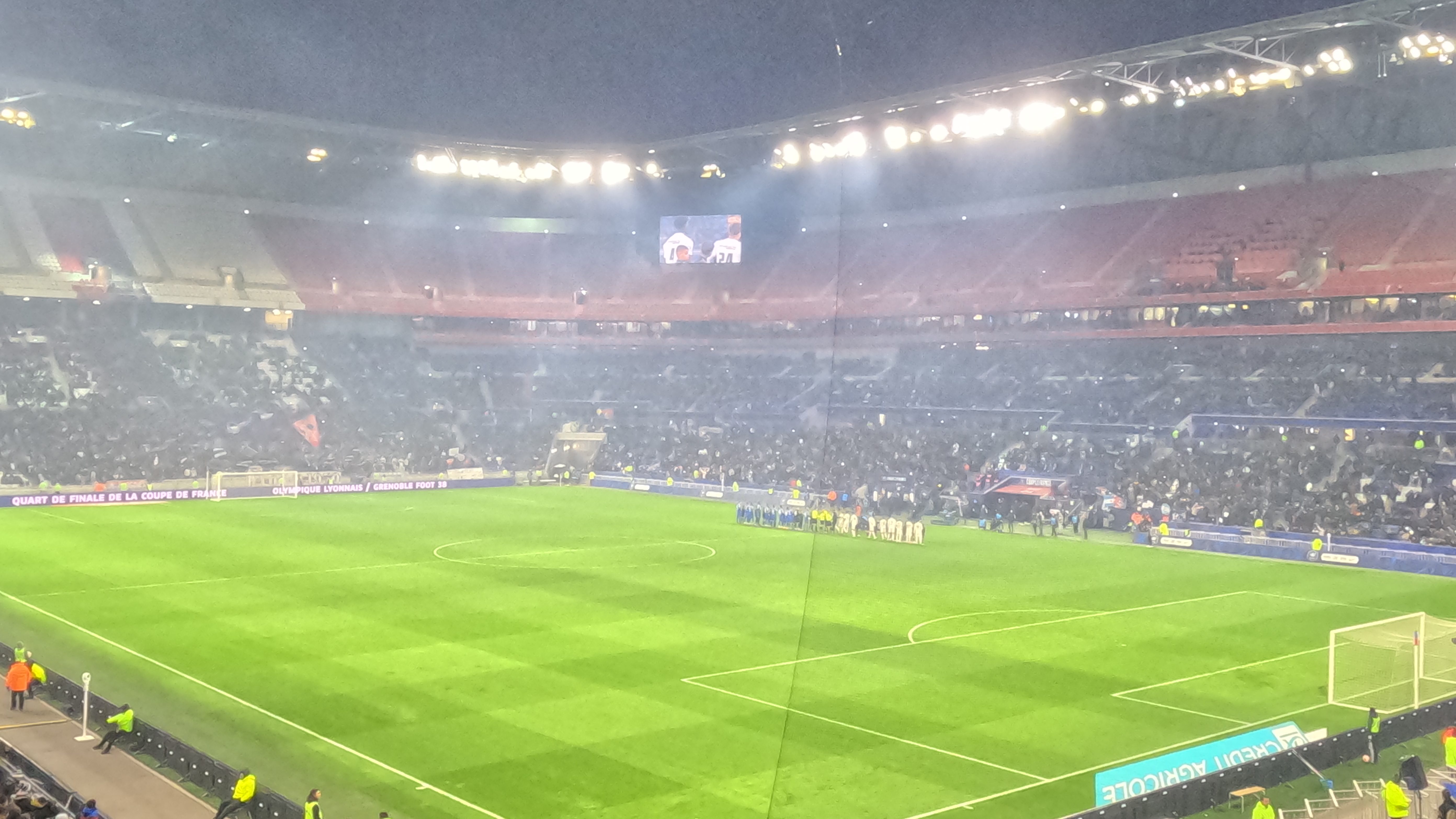
    Smoke from pyro lit in the away section, during the pre-game light show, clouding over the field as the players line up.

    While the Lyon Ultras were still jumping up and down to the tune of ‘qui ne saute pas n’est pas Lyonnais’ (Who does not jump is not Lyonnais) Grenoble nearly scored, just a few seconds off the restart. Once again, their direct approach penetrated the Lyon back-line, but Lopes thwarted Pape Meïssa Ba to keep Les Gones’ lead intact.

    OL retaliated ferociously and had multiple massive chances to further their lead. In the 28th minute, a series of exquisite tiki taka passing led to another Barcola header, but this time GF38’s goalkeeper Esteban Salles was able to parry it away. The next minute, Maxence Caqueret split the Grenoble defense with a brilliant pass to Barcola but Salles came flying off his line – like superman – and made a ridiculous save.

    Lyon’s Jeffinho was causing havoc down the left wing throughout the first half and his exploits led to Les Gones’ second goal in the 34th minute. The Brazilian got on the end of a Tagliafico through ball, beat his man for pace and poked it past Salles for OL’s second. As we were celebrating, more moderately this time, I caught a glimpse of Jeffinho’s cartwheel/backflip celebration out of the corner of my eye.

    Lyon continued to dominate but could not add to their lead before halftime. During the break, the kid and his brothers/friends began pressing Anthony for money, for the torn jacket. I was in a very unfortunate position, so I decided to just hang around by my seat without getting involved in the argument.

    The second half was overshadowed by the crisis at hand, which got more heated as the half progressed. Nevertheless, I was able to focus enough of my attention on the match to catch some of the more significant moments.

    In the 53rd minute, for example, Salles made another fine one-on-one save to deny Moussa Dembélé from scoring OL’s third. Unfortunately, the French goalkeeper got hurt in the possess and had to be subbed off. Caqueret, a Lyon academy product, was phenomenal in midfield throughout the game and he created so many big chances for Les Gones, including this one.

    During the latter part of the second half, Grenoble began pushing harder for a way back into the game. In the 69th minute, they nearly pulled one back but a few mishits from inside the box saved Lyon some blushes. Three minutes later, GF38 almost capitalized on an OL mistake in midfield, but Abdoulie Sanyang’s first attempt was saved by Lopes (who came flying off his line) and his second was blocked in front of the goal by Sinaly Diomandé. However, the visitors continued to exploit Lyon’s weaker right side and a combination of luck and perseverance led to their first goal in the 75th minute – Cacqueret’s attempted tackle diverted the ball straight to the feet of an otherwise offside Amine Sbaï, who rounded the keeper and scored.

    The OL Virage Sud Ultras, who we were sitting adjacent to, were in great voice all game long.

    It was a nervy end to the match for Lyon, but they held on for another successful Coupe de France outing (A few days later, they were drawn to play FC Nantes away in the semi-final). The Virage Sud was once again bouncing to the tune of ‘qui ne saute pas n’est pas Lyonnais’ as the players came over to acknowledge them.

    Even though OL looked slightly sluggish in the second half and were missing some big names like Alexandre Lacazette, Jérôme Boateng, and Dejan Lovren, they played some quality football. I particularly enjoyed watching the Cacqueret masterclass in midfield and the goalkeeping showdown in both ends. It was my first French football experience, and though it was stained by the torn jacket saga, I must say the OL ultras (and the travelling Grenoble fans) were fantastic – I can only imagine what the atmosphere would be like for a Saturday evening kick-off against a big league opponent.

    July 15, 2025
    Football, Groundhopping, Ligue 1

  • Slavia Prague vs Slovacko: My Fortuna Arena Experience

    (Originally published on March 24th, 2023)

    In the past six years, Savia Prague has been the most dominant football club in Czech Football, having won the league four times and finishing second twice. They have become regulars in European competitions and even played the likes of Barcelona, Inter and Dortmund in their 2019/20 Champions League campaign. In the current domestic season, they find themselves in a tight title race against fellow Czech giants Viktoria Plzeň. Going into Gameweek 21, they had a slender two-point advantage, but after Plzeň’s win on Saturday they needed a win or draw against fourth placed Slovácko on Sunday (26th February 2023) to get back on top. However, this would not be an easy task as the visitors had not conceded in 360 minutes and had defeated Plzeň 3 – 0 just the previous week.

    The entrance to the Slavia Museum at Fortuna Arena. The large banners pay tribute to Slavia legends and the silverware they have won.

    I happened to be visiting Prague for the weekend, so I decided a Sunday afternoon at Fortuna Arena would be the perfect way to cap off my trip. My friend Hrishikesh, who I used to play youth football with in India, was also going to head over from Linz, Austria (where he is studying), so it was going to be a good time.

    My goal for this game was to get to Fortuna Arena a good two hours before kickoff, so I could visit the Slavia Museum and get myself a scarf before they sold out. Unfortunately, I was well behind schedule as I was busy visiting Prague Castle and the Josofov district. When I did decide to head to the stadium, I missed my tram (by waiting at the opposite side of the road), so that delayed me further. Luckily, I caught the next one and had a great conversation with a group of Slavia fans on the way to the stadium. I also got a glimpse of Ďolíček Stadium, the home of Bohemians 1905 (one of the other two first division clubs in Prague), which was just two tram stops before Fortuna Arena. I got to the stadium with about thirty minutes to kick-off but the line to the fans shop was massive. By the time I did get into the shop and buy a scarf, there was only a few minutes to kick-off, so I rushed inside in an attempt to find my seat before the opening whistle.

    In the end, I reached my seat just as the players were walking onto the pitch. Hrishikesh and I were seated high in a packed František Veselý stand, that runs along the touchline. The Slavia Ultras filled the North Stand, which was behind the goal to our right, while the visiting Slovácko fans were given a small corner to our left. Being a club from Uherské Hradiště, a town of just 24,000 inhabitants, Slovácko did not have a lot of travelling supporters.

    I must say I took an immediate liking towards Fortuna Arena, a modern, yet relatively small stadium with just under 20,000 seats. Three of the four stands have only one tier, making them steep, compact and loud – the perfect ingredients for a great footballing atmosphere.

    Our view of the action from the second last row of the František Veselý stand.

    Before kick-off, a moment of silence was held for Marin Pěnička, former Slavia player and a 1996 league champion, who passed away at 53 that week. The Czech Fire Department, along with its Urban Search and Rescue team, were also recognized for their relief efforts in Turkey following the recent earthquakes. Due to all this, kick-off was delayed, and we were able to soak in the atmosphere despite arriving quite late.

    When it did kick-off there was some very commendable football on display. Slavia is a very possession-oriented team, and they had some impressive build ups and passing combinations throughout the game. However, their opening goal of the game, which came in the 12th minute, was as direct as it gets. 20-year-old Slavia midfielder Christos Zafeiris sent in an out swinging corner, which was headed home, quite emphatically, by Peter Olayinka.

    Slavia continued to work the ball around the Slovácko box, and in the 29th minute an impressive string of passes put David Jurásek through on goal. However, some proactive goalkeeping from Slovácko’s Filip Nguyen prevented Jurásek and Slavia from doubling their lead.

    Slovácko’s best chance of the first half came in the 36th minute when they attempted a set play from a deep free-kick. The ball was driven down the line, into the Slavia box, to the near-post runner, Michal Kadlec, who then crossed it in across goal. Unfortunately for Slovácko, there was no one at the far post and the ball went harmlessly out of play.

    Slovácko had another opportunity to equalize late in the first half. Marek Havlík won the ball off Zafeiris just outside the Slavia box, but his low drive was beaten away by Ondřej Kolář, Slavia’s netminder.

    At halftime, Hrishikesh and I decided to walk around inside the stadium and explore a little bit. Unfortunately, the concourses were crowded with people trying to get a halftime beer, so we could not get around all that much. Between the bodies, we caught glimpses of some incredible murals on the inside walls of the North Stand, but a glimpse was all we could manage.

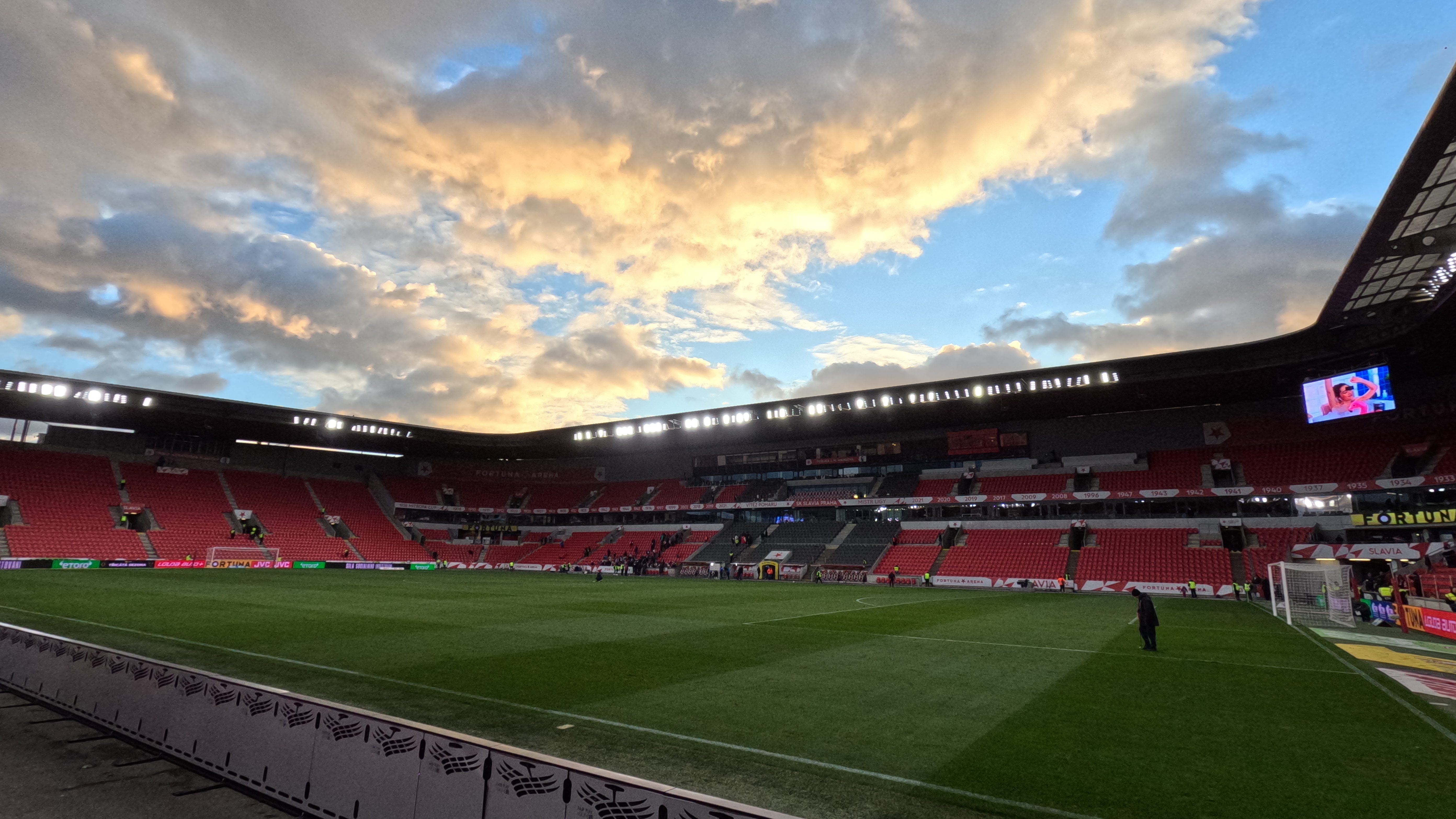
    As the second half kicked off, the sun began setting behind the J.W. Madden Stand, which made for an extremely pleasant view and the oblique rays momentarily relieved us from the intense cold.

    Slavia continued to dominate proceedings and were looking to extend their lead. In the 66th minute, they broke mercilessly on the counter, after David Douděra won a fifty-fifty ball in midfield, but the attack was shut down by another significant one-on-one stop from Nguyen.

    A few minutes later, Slavia doubled their lead from another corner, and it was Frank Olaynika who got the decisive touch once again. It was not so direct this time, as the initial cross was deflected beyond the far post, but some poor defending allowed a second more threatening cross, which caused the damage.

    Pitch-level post-game pictures go hard, especially when the sky is that beautiful.

    Despite some more half chances for both teams, the game finished 2 – 0 and Slavia returned to the top of the table after a brief 22-hour absence. The Slavia Ultras were loud for the entirety of the game, though it was not a big enough occasion for them to bring out the pyro and tifos that they are known for. After the game, we walked around to the front of the stadium, which housed the Slavia Museum and exhibited large banners of legendary Salvia players (including Vladimír Šmicer), for some pictures. Despite Czechia not necessarily being known for its football, I really enjoyed this experience. Maybe it was because I watched it in the company of a friend whom I had not seen for five years, or because of the golden hour sun that shone onto the pitch for half the game. Nevertheless, it brought a happy end to a very successful trip to Prague.

    July 15, 2025
    Czech First League, Football, Groundhopping

  • Grasshopper Club Zurich vs FC Zurich: My Letzigrund Experience

    (Originally published on March 21st, 2023)

    Grasshopper Club Zurich vs FC Zurich, the Zurich Derby, is one of the oldest derbies in European football and the only intra-city rivalry in Switzerland. The first Zurich derby was played in 1897, and the two teams have played each other over 250 times (officially) since then. The rivalry was founded on the traditional class conflict – with GC representing the wealthy and FCZ being the working-class club. Nowadays, those lines are blurred but the rivalry continues to be a heated one.

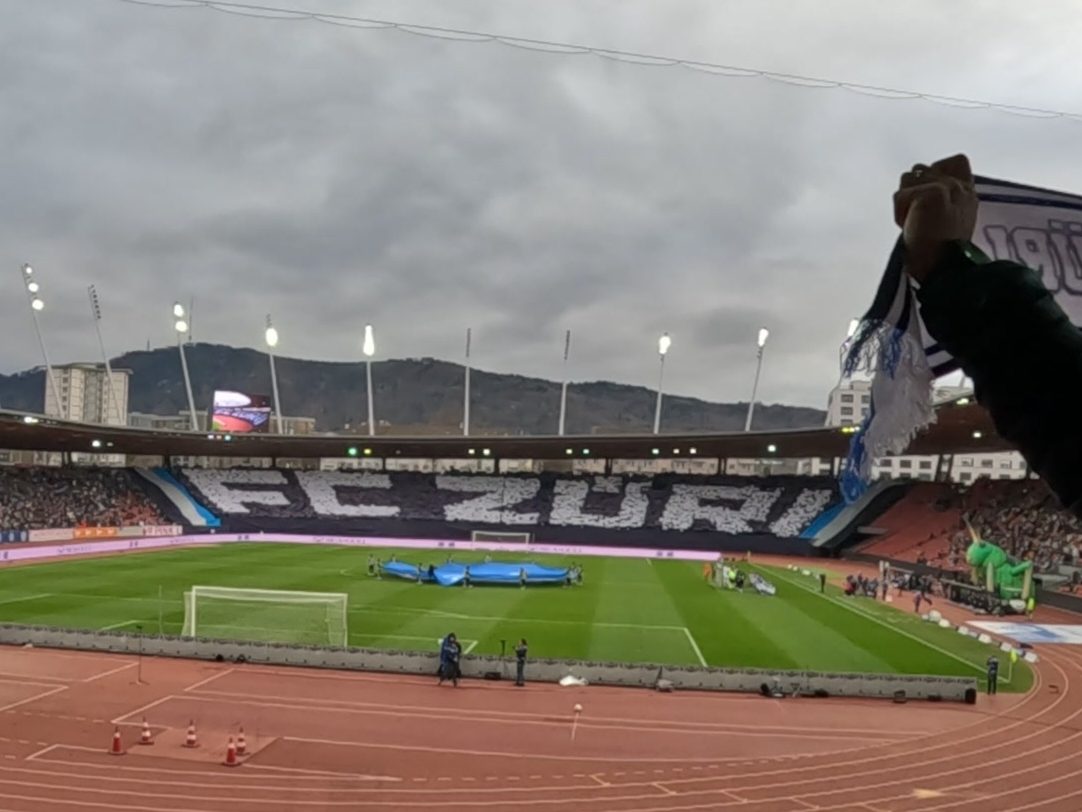
    Massive paper tifo in the FC Zurich end , welcoming the players as they walk onto the field.

    Grasshoppers happen to be the most successful team in Switzerland (with 27 league titles and 19 cups) but in the past two decades they have struggled to add any silverware, barring a Cup success in 2012/13. In 2019, their decline was epitomized by relegation into the Swiss second division for the first time in 68 years. However, they returned to the Swiss Super League in the 2020/21 season.

    FCZ, on the other hand, is the more popular club in the city and they have had much more success in the recent past. Since GC’s last league success in 2003, FCZ have won the league four times. In fact, they are the defending champions and their ultras, the Zürcher Südkurve, gained a lot of notoriety and praise for their travels to Arsenal, Bodø/Glimt, and PSV in FC Zurich’s Europa League campaign this season.

    In the past fifteen years, the Zurich Derby has turned violent in the stands on multiple occasions. The worst of it occurred in 2011, when a league match had to be suspended in the 77th minute due to brawl in the stands spilling over onto the pitch. In 2021 and 2022, fans have clashed both outside and inside the stadium. The Swiss FA has fined both teams several times and has even considered banning away support for derby matches.

    Studying abroad in Switzerland for four months, I simply could not miss the local derby. I got two CHF 20 tickets for the 22/23 Swiss Super League’s third Zurich Derby, which took place on the 19th of February, and dragged my friend Jameson along with me.

    This being a GC home game, we got tickets in the Nord Stand in the home section, adjacent to the GC ultras. Due to our packed travelling schedule however, we reached the Letzigrund only a few minutes before kickoff. Therefore, we missed the pre-match build up outside and inside the stadium and I had no time to buy a GC scarf – I was extremely disappointed. Just as we walked in and found our seats, Das isch GCZ, the Grasshopper’s anthem began playing. Considering it was only released 5 months ago, not many people sang along, but it might be my favorite club anthem yet. Then, as the players began to walkout through the massive grasshopper prop, the FC Zurich fans on the opposite Sud Stand choreographed a paper tifo that read FC Züri.

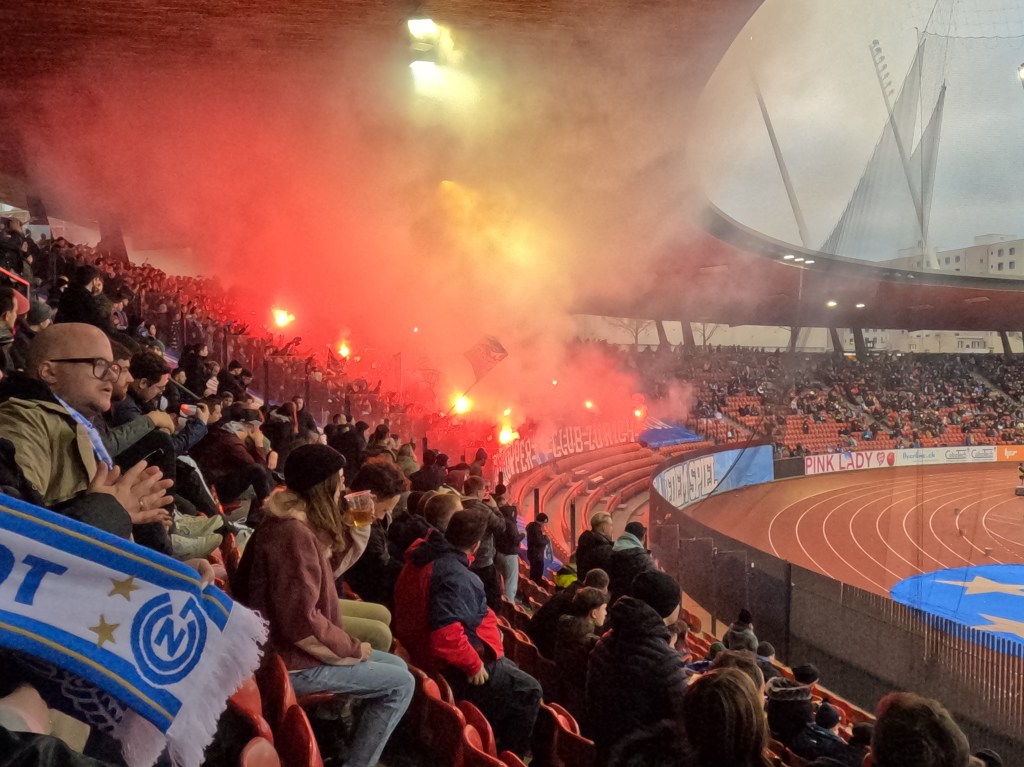
    Having had my first taste of Swiss football a couple of weeks back, I knew what was coming once the game kicked-off. As soon as the referee blew his whistle, the Grasshopper ultras lit pyro and their FCZ compatriots did not hesitate to follow suit.

    Pyro galore in the GC Ultras section, after an FC Zurich goal was disallowed by VAR.

    The first half was extremely untidy. After watching Inter Milan just the day before, it was hard not to notice the decline in quality. Grasshoppers started the game on the front foot, and they came close to scoring in the very first minute. A scrappy build up put Hayao Kawabe through on goal but a strong hand from Yanick Brecher, the FCZ goalkeeper, kept the game level. Two minutes later, GC had another opportunity to open the scoring, but this time Dominik Schmid blazed over from 18 yards out. The GC ultras, who sat to our left in the Nord stand, were loud but they were no match for the Zürcher Südkurve on the opposite side. The entire Sud stand was packed with FCZ fans, with no empty seat in sight. The noise they made carried all the way to our side and drowned out the GC support beside us. I wish I knew why, but there simply were not as many GC fans to fill up the home section and the ultras’ section was quite small in comparison to that of FCZ on the opposite side.

    Nevertheless, Grasshoppers were the better team on the field in the first half, and they took the lead in the 30th minute through a Renat Dadashov penalty kick. Now, the GC ultras got really loud and the mood in our stand was great.

    At halftime, I went looking for a place that sold Grasshopper scarves. I found a singular stall selling GC gear, but they were all sold out of scarves – tragic. With nothing else to do for the remainder of the break, I returned to my seat and formulated some thoughts on the stadium: The Letzigrund, which has been the home of both Zurich teams since 2007, is a unique stadium. It is a large, single-tiered, oval bowl with a massive running track separating the stands from the field. Sitting behind the goal, you can barely see any of the action at the opposite end. What you can see however, are distant mountains peeking over the roof of the stadium – typical Swiss. Despite how ‘anti-good footballing atmosphere’ this place might sound; it gets quite colorful with all the pyro and smoke bombs. And the lack of proximity to the pitch does not stop the fans (FCZ’s in particular) from making a lot of noise – which travels with intensity to all parts of the ground.

    Going back to the game, the second half started much the same as the first – to a pyro display from both sets of fans. In the 54th minute, GC came extremely close to doubling their lead off a corner, but Dadashov’s header went agonizingly wide. FCZ, who were now attacking towards the Südkurve, were piling on the pressure in an effort to find the equalizer. In the 59th minute, they managed to put the ball into the GC net and the Südkurve went berserk – flares, noise, everything. However, the goal was checked by VAR and eventually ruled out for a handball in the buildup. Now, it was GC fans’ turn to celebrate and they did not hold back.

    Unfortunately, the joy in the Nord stand did not last long as FCZ’s Tosin Aiyegun put the ball in the net just seven minutes later and this time there was no debate. The place around me went silent, while the FCZ players went to celebrate in front of the Südkurve. Later in the 73rd minute, Aiyegun scored again and FCZ turned the game around. The noise drifting our way from the Südkurve was now louder than ever and I could not help but feel sorry for the stunned GC fans around me.

    The Zürcher Südkurve celebrating FCZ’s second goal, long after the game has restarted.

    In the 85th minute, FCZ nearly extended their lead through a Cheick Condé long range drive but GC goalkeeper André Moreira made an outstanding fingertip save which kept his side within one. For the remainder of the game, GC tried desperately to find the equalizer. They won several corners and a dangerous free-kick, but could not find the elusive equalizer – FC Zurich had earned a famous comeback derby victory.

    ‘Simply devastated’ is how I would describe the emotions of the GC fans around me. I waited to see the reaction when the Grasshopper players came over to acknowledge their fans and it was one of the most interesting interactions I have ever seen. The players walked across the field, jumped over the advertisement boards (onto the running track) and simply stood in front of the GC Ultras, almost as if in apology. It reminded me of a dog with its tail-down, looking up at its owner for forgiveness. Many of the GC ultras applauded timidly, while a minority shouted out words accompanied by aggressive gestures (Not knowing a word of Swiss-German, I can only assume they were curses).

    On the opposite side, the FCZ fans celebrated loudly and lavishly with their players. The noise they made was immense, even at our end, and the Zürcher Südkurve were in no hurry to leave the stadium.

    Walking back amongst the GC fans was quite depressing. I could not help but wonder how enjoyable this walk could have been if GC had held on to their early lead. As we neared the tram station where we got off, we saw dozens of cops in full riot gear and barricades blocking trams from going through. As a result, we had to walk the distance of two-three tram stops to reach the nearest functional one and catch the necessary tram. While researching for this blog post, I discovered that the post-game tram access to the Letzigrund has been blocked since February of 2022 as Swiss authorities had deemed that the safety of tram operators and passengers is no longer guaranteed in these circumstances.

    Once we eventually made it back to Zurich HB (the train station) for our journey back to Geneva, I noticed hundreds of teenagers/young men wearing FCZ sweatshirts, and none with GC. Perhaps it would have been different if Grasshoppers had won, but after all I have seen at the derby, I am not so confident. GC just does not seem to be a very popular club in Zurich, from what I have noticed both inside and outside the stadium. Nevertheless, I feel very fortunate to have been able to catch the Zurich derby while in Switzerland and this experience has given me some burning questions about football in Zurich and this country as a whole.

    July 14, 2025
    Football, Groundhopping, Swiss Super League

  • Inter vs Udinese: My San Siro Experience

    (Originally published on March 10th, 2023)

    The San Siro is one of the grandest theaters of World football. Its architecture is simply iconic, like a massive oil rig set in suburban Milan. It is historic, having opened in 1927, and is the home of two Global footballing giants – AC Milan and Internazionale. The stadium is massive with a seating capacity of almost 80,000, making it the largest in Italy and 6th largest in Europe. It has played host to some of the most dramatic and memorable games of football, and watching a game here is on every football fan’s bucket list.

    Inter
    Our view from the heavens at the San Siro (We were a lot closer to the action than it appears in this wide-angled GoPro shot).

    With the San Siro being only five hours away, from Geneva (where I am studying abroad), and with one of the Milan teams playing at home every weekend, it was only a matter of time before I made a trip down there. The stars aligned for Inter’s clash with Udinese on 18th February 2023 and I was able to snag tickets for a student-friendly €15.

    After a panic-stricken train ride back from Lake Como on matchday (I thought I had not bought the tickets after reading an email that said my payment had not gone through), my friend Jameson and I reached our hostel and made plans for a last-minute dash to the box office. Luckily, I decided to check my other email account and found the tickets there, so we were able to take a more relaxed stroll to the stadium.

    The route took us along this long wall (enclosing a horseracing track) and it was covered in graffiti and murals. Many of them were football related – tributes to former Milan/Italy legends and famous victories. As we got closer to the stadium, we found a food truck and got a quick pre-game snack. I got myself an Inter scarf from one of the many vendors outside the stadium for just €10. There was a very interesting selection of scarves, including one with Bart Simpson pissing on an AC Milan badge, but I stuck with a relatively simple design.

    We took our time outside the stadium and by the time we decided to go in (15 minutes before kick-off) the line outside our gate was massive. With about 5 mins left, we got through, but we still had the long winding, yet iconic, spiral staircases of the San Siro to ascend. When we eventually reached our seats, which were in the very last row of the Tribuna Rosso (Red Stand), the match was already 45 seconds in.

    Inter
    The struggle to get into the San Siro was real, but it only meant we had more time to look up in awe at this magnificent footballing edifice.

    Sitting in the highest row, by the half-line, gave us an excellent bird’s eye view of the game. Having sat behind the goal in all the games I have attended so far in Europe, this was a pleasant change as I was able to see everything that was happening on the pitch. In our section, the seats were so close to each other that we were packed together like sardines. I was shoulder to shoulder with the person on either side of me and there was no leg room whatsoever (not that I cared). Our stand was extremely steep and the rows in front of us felt like they were directly beneath us. Looking up, I felt I could almost touch the roof of the stadium and the catwalk was just above our eye line. The stand to our left was occupied by the Inter Ultras (the Curva Nord), while the Udinese supporters were given a section high up in the opposite end .

    During the first half, it was all Inter. They completely dominated proceedings and Udinese were content with sitting back and defending. Romelu Lukaku, despite his struggles at Chelsea and with Belgium in the World Cup, was extremely successful in his hold-up striker role at Inter. The midfielders would constantly target him with their longballs, which he would settle, thereby establishing a more advanced position for Inter to start their attacks. Lukaku continued to be a nuisance for the Udinese defenders and in the 15th minute his cutback to Edin Džeko caused chaos in the Udinese box and led to an Inter penalty. Lukaku stepped up to take it, but his penalty was tame and was saved by Marco Silvestri, the Udinese keeper. The Inter fans immediately began chanting Lukaku’s name to show their unconditional support for him, and after seeing that I could kind of understand Lukaku’s controversial comments in that infamous interview at Chelsea. Fortunately for the Belgian, Silvestri stepped off his line too early so Inter were handed a re-take. This time, Lukaku buried his penalty into the bottom right corner and the Nerazzurri took an early 1 – 0 lead.

    Later, in the 42nd minute, Lukaku continued to be in the limelight but this time for the wrong reasons. His giveaway in midfield sparked a devastating Udinese counterattack, which concluded with Sandi Lovric scoring the equalizer. While Udinese did have some opportunities, this goal came so late in the first half and so much against the run of play that the San Siro was momentarily in shock.

    Inter
    The Curva Nord (Inter’s Ultras) were bouncing all game long. Rather than cursing at players when they make a mistake, the Curva Nord sing their names to urge them on – a great sight to see at the football.

    At half-time, we decided to stay near our seats and not really explore the stadium because we had to descend so many steps and the concourses were packed. I took the time to reflect on the first half and these were my thoughts – The noise and atmosphere in the San Siro is something I will never forget. Even though this was a standard league game against a mid-table Serie A opponent, the attendance was a whopping 71,248. There was plenty of noise coming from the Curva Nord, and it was quite loud even where we sat. The popular songs would often catch on with fans in other stands and the noise would be breathtaking. Whenever there was an officiating decision that the inter fans did not like, the whistling was deafening, and the noise rose up the stadium until it reached us. Seeing this, I could not even imagine what the San Siro would have been like four days later when Inter hosted Porto in the Champions League.

    During the second half, Inter continued to pile on the pressure. An impressive exchange of passes between Henrikh Mkhitaryan and Federico Dimarco in the Udinese box led to Inter’s first big chance of the second half, but Silvestri was equal to Mkhitaryan’s thumping drive. A few minutes later Džeko had a great opportunity, after Udinese’s defender Rodrigo Becão was caught in possession, but Slivestri made another crucial save to keep the game level.

    At midpoint of the second half, the game opened up as both teams were searching for the go-ahead goal. In the 72nd minute, Udinese had a great opportunity when Isaac Success led a four against two counterattack. To the disappointment of his teammates, he chose to take it himself and his shot was blocked by a retreating Denzel Dumfries. The very next minute, Inter made Udinese pay for their missed opportunity through Mkhitaryan’s well taken volley from the edge of the box.

    While celebrating this goal, the guy sitting next to me spilled his beer on my jacket which sparked a great conversation. Turns out that he is from Nantes and is therefore an FC Nantes supporter. The Inter game was the culmination of his trip that included watching Nantes draw 1 – 1 with Juventus in Turin, and skiing in the Italian Alps. When his friends came to hand him another beer, they saw me filming on my GoPro and began singing Nantes chants at the top of their voice. It was such a great time, and it was nice to see other tourist fans.

    In the 88th minute, World Cup Winner Lautaro Martínez (who had come on for Lukaku) found himself bearing down on the Udinese goal with the chance to seal the game. However, he tried to chip the keeper and ended up putting it over the crossbar – a disappointing end to a promising attack. Just a minute later, he was through on goal yet again with the opportunity to redeem himself. This time, the Argentine smashed home into the top corner and wheeled off to celebrate in front of the Curva Nord. Udinese could not muster up another equalizer and the game ended 3 – 1 in favor of the Nerazzurri.

    As we left the San Siro, everyone was in high spirits which was great to see. Several fans were still singing at the top of their lost voice on their way out. Walking down the San Siro spirals, when in no hurry, was a vibe. You could see thousands of fans descending the adjacent spirals which made for quite the optical illusion. I think this was definitely one of my favorite football experiences in Europe so far, because the atmosphere lived up to the hype. Given the weight of the fixture, there was not much of a pyro show or tifo display in the Curva Nord . But, just the manner in which the songs rang through the San Siro was mind-blowing in itself.

    On another note, the San Siro is set to host the opening ceremony of the 2026 Winter Olympics, but plans have been made for it to be demolished and rebuilt (in an ambitious and modern fashion) after that. So, if you have the San Siro experience on your bucket list, make sure you try and get out there in the next three years before the San Siro, as we know it, is no more.

    January 29, 2025
    Football, Groundhopping, serie-a

Previous Page Next Page

Blog at WordPress.com.


Loading Comments...
 

    • Subscribe Subscribed
      • En Eluttukal
      • Already have a WordPress.com account? Log in now.
      • En Eluttukal
      • Subscribe Subscribed
      • Sign up
      • Log in
      • Report this content
      • View site in Reader
      • Manage subscriptions
      • Collapse this bar